Ordering too little bottled water can disrupt daily operations, while ordering too much can tie up working capital and occupy valuable storage space. For hotels, corporate offices, event organisers, retailers and distributors, estimating consumption before placing an order makes bottled water procurement easier to manage.
Understanding your bulk bottled water requirements starts with a few practical inputs: the number of people you serve, expected consumption, operating days, seasonal demand and the time needed to replenish your stock.
This guide explains how to estimate the bottled water quantity your business needs, plan for peak demand and establish a sensible reorder point. These calculations can also help you prepare a clearer supply enquiry for Not A PET Bottle if you are considering finished drinking water in PLA-based bottles.
1. Start by Identifying Who Will Use the Water
Your calculation should reflect the people who will actually consume the bottled water. The requirements of an office supplying meeting rooms will differ from those of a hotel providing water to every occupied room.
Identify your main consumption groups before estimating quantities.
- Employees: Staff members who receive bottled water during working hours.
- Guests and visitors: Customers, clients, hotel guests or other visitors.
- Event attendees: People attending conferences, exhibitions, weddings or other functions.
- Retail customers: Customers purchasing bottled water for personal use.
- Distribution customers: Retailers or businesses supplied by a distributor.
Avoid counting the same person twice. For example, if employees are already included in the daily office estimate, do not add them again under meeting attendees unless their additional consumption is genuinely expected.
2. Calculate Average Daily Bottled Water Consumption
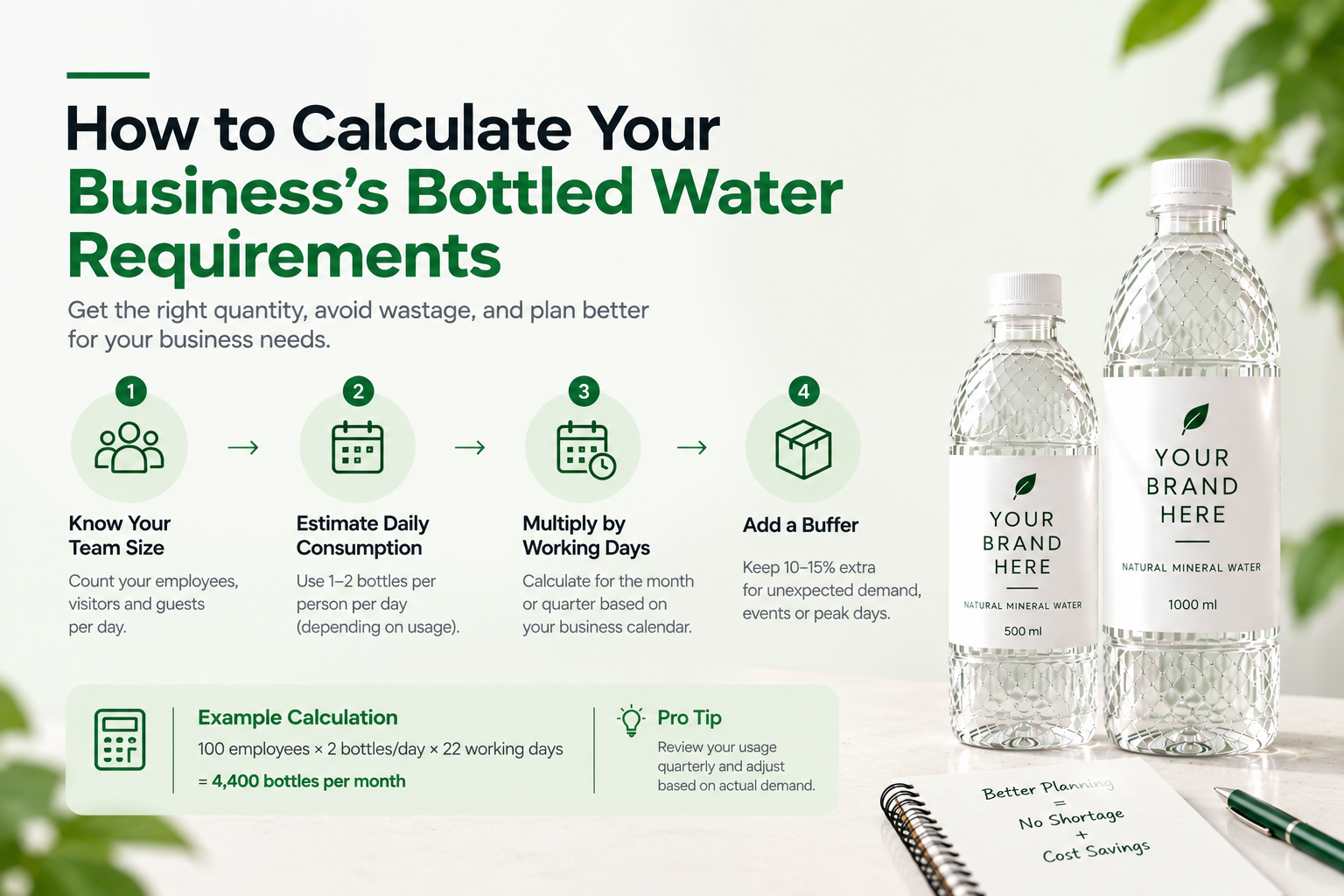
A useful starting point is to estimate the number of bottles consumed by each group on a typical day.
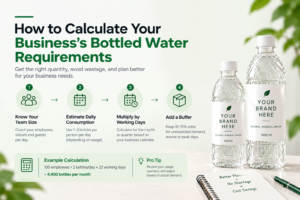
Use this formula:
Daily bottle requirement = Number of people × Average bottles per person
If different groups have different consumption patterns, calculate each group separately and add the results.
Example: Corporate Office
Suppose an office estimates the following daily demand:
| User group | People per day | Planned bottles per person | Daily bottles |
|---|---|---|---|
| Employees | 80 | 1 | 80 |
| Visitors | 15 | 1 | 15 |
| Meeting attendees | 10 | 1 | 10 |
| Total | 105 | — | 105 |
In this example, the estimated requirement is 105 bottles per working day.
These figures are illustrative, not a recommended consumption standard. Your actual requirement will depend on bottle size, drinking habits, operating conditions and whether other drinking water options are available.
For businesses using refill stations or larger water dispensers alongside bottled water, estimate only the portion expected to be supplied in bottles.
3. Estimate Requirements for Your Business Type
Different businesses need different calculation methods. Choose the approach that best reflects your operations.
Corporate Offices
Start with the number of employees present on a typical working day. Add expected visitors and additional demand from meetings, training sessions and conferences.
If employees work in shifts or follow hybrid schedules, use actual attendance rather than the total number of employees on the payroll.
Calculation: Daily employees’ demand + visitor demand + additional meeting demand.
Hotels and Hospitality Businesses
For hotels, consider occupied rooms, average guests per room, the number of days covered and your normal bottled water allocation.
For example, a hotel may calculate guest-room demand separately from conference rooms, restaurants and other facilities. This helps identify which areas account for the largest share of consumption.
Calculation: Occupied rooms × Planned bottles per room per day, plus other operational requirements.
Events and Weddings
For events, begin with expected attendance and estimate bottles per attendee for the event duration. Consider whether water will be available throughout the event, whether other serving options exist and whether the schedule includes multiple sessions.
If attendance is uncertain, prepare a base estimate and a separate higher-attendance scenario rather than automatically ordering for the largest possible number.
Calculation: Expected attendees × Planned bottles per attendee, adjusted for event duration and service arrangements.
Retailers and Distributors
Retailers and distributors should calculate expected sales rather than personal consumption.
Use recent sales data, expected demand, current inventory and the time required to replenish stock. If demand varies by day or season, examine those patterns before deciding how much inventory to purchase.
Calculation: Expected sales during the replenishment period, adjusted for existing stock and planned reserve inventory.
4. Account for Peak Demand and Seasonal Changes
Average daily consumption is a useful baseline, but it may not represent your busiest periods.
Demand can increase during conferences, wedding seasons, festivals, higher hotel occupancy, large client meetings or periods of unusually high footfall.
Review your previous consumption records where available. If you are planning a new operation or event, estimate demand using expected attendance and the activities scheduled.
A practical approach is to prepare three scenarios:
- Normal demand: Expected consumption on a typical operating day.
- High demand: Consumption during a busier-than-usual period.
- Exceptional demand: A large event, seasonal peak or other unusual requirement.
For example, a business that normally uses 100 bottles a day might plan for a higher quantity during a conference. The additional requirement should be based on expected attendance and usage rather than an arbitrary percentage.
Separating these scenarios helps you plan for demand changes without treating every day as a peak-demand day.
5. Calculate Your Total Order Quantity
Once you have estimated daily consumption, calculate the quantity required for the period you want to cover.
Required bottles = Estimated daily consumption × Number of days covered
Suppose a business uses 105 bottles per working day and wants to plan for 20 working days.
105 × 20 = 2,100 bottles
This is the estimated consumption for the period before accounting for existing inventory, expected demand changes or any additional reserve.
For a more practical purchase calculation, use:
New order quantity = Expected consumption during the planning period + Planned reserve − Usable stock already available
The planning period might cover a week, a month or the time until your next confirmed delivery.
For retailers and distributors, consider stock already committed to customers. For offices and hotels, exclude stock that is damaged, unsuitable or otherwise unavailable for use.
6. Set a Reorder Point Before Stock Runs Out
A reorder point tells you when to begin arranging the next purchase. It helps reduce last-minute orders and makes recurring bottled water supply easier to manage.
A basic formula is:
Reorder point = Average daily consumption × Replenishment lead time + Safety stock
Replenishment lead time is the number of days between initiating an order and having the usable stock available.
Example: Monthly Office Supply
Assume an office uses 105 bottles per working day. The confirmed replenishment lead time is five working days, and the business chooses to maintain a reserve of 100 bottles.
The reorder point would be:
105 × 5 + 100 = 625 bottles
In this example, the office should begin arranging replenishment when usable stock approaches 625 bottles.
The five-day lead time and 100-bottle reserve are illustrative. Use your supplier’s confirmed lead time and a reserve that reflects demand variability and the consequences of running out.
For recurring supply, review the reorder point whenever consumption patterns or delivery arrangements change.
7. Avoid Ordering More Bottled Water Than You Need
Excess inventory can create avoidable costs and operational problems. Bottled water takes up storage space, requires stock handling and ties up money that could be used elsewhere.
To improve inventory planning:
Track Actual Consumption
Record the quantity received, used, sold or distributed over each period. Compare actual demand with your original estimate.
Review Stock Regularly
Check usable inventory before placing another order. Include incoming orders where appropriate, but avoid relying on deliveries that have not been confirmed.
Match Orders to Storage Capacity
Consider how much stock your premises can safely and practically store. Follow the supplier’s storage and handling guidance for the specific product.
Avoid Excessive Safety Stock
A reserve can help manage uncertainty, but an unnecessarily large reserve may increase storage and working-capital requirements. Base it on consumption variability and replenishment risk.
Review Slow-Moving Inventory
Retailers and distributors should pay particular attention to stock that sells more slowly than expected. Adjust future order quantities to reflect actual sales rather than the original forecast.
A simple spreadsheet recording daily usage, remaining stock, incoming orders and supplier lead times can make this process easier.
8. Consider Bottle Specifications and Packaging Requirements
Bottle specifications affect how you plan storage, transport and supply. Confirm the product requirements before finalising the order quantity.
If you are considering PLA-bottled drinking water, ask the supplier to confirm the available finished-water product, bottle specifications and supporting documentation.
PLA stands for polylactic acid, a polymer commonly produced from fermented plant-derived sugars or starches. It is used in selected packaging applications, but its environmental performance depends on the specific product and disposal conditions. Do not assume that every PLA-based bottle is compostable or biodegradable in all environments.
You should also confirm whether the available product meets your operational needs, including storage requirements, packaging information and relevant product documentation.
Explore the available packaged drinking water options and natural mineral water options to review the relevant product offerings. Confirm the specific product, packaging and supply details directly before making a purchasing decision.
9. Prepare a Clear Bottled Water Procurement Plan
Once you have estimated consumption and identified the appropriate order quantity, prepare a short procurement brief.
Include the following information:
| Requirement | Details to Record |
|---|---|
| Business type | Office, hotel, event, retailer or distributor |
| Intended use | Employees, guests, attendees or resale |
| Estimated consumption | Bottles per day, week or month |
| Initial order quantity | Estimated quantity required |
| Peak demand | Known events or seasonal increases |
| Current inventory | Usable stock already available |
| Reorder point | Stock level at which replenishment should begin |
| Product requirements | Drinking water and required packaging specifications |
| Branding | Whether an approved branding arrangement is needed |
| Delivery details | Destination, required date and receiving arrangements |
This information gives your supplier a clearer understanding of the requirement and helps make the quotation process more efficient.
For businesses considering finished drinking water in PLA-based bottles, it is especially useful to state that packaging preference clearly in the initial enquiry.
10. Discuss Your Bottled Water Requirements with Not A PET Bottle
Not A PET Bottle focuses on finished drinking water in PLA-based bottles for businesses exploring alternative bottled water packaging.
If you are considering a potential bulk supply arrangement, a consumption estimate can help make the commercial discussion more specific. Sharing your expected quantity, intended application, delivery location, preferred timing and branding requirements gives the team a clearer picture of what you need.
Product availability, packaging specifications, order quantities, branding options, delivery feasibility and commercial terms should be confirmed directly.
You can explore the packaged drinking water range, review the product range, or discuss your requirements with the team.
Frequently Asked Questions
How do I calculate bulk bottled water requirements for my business?
Estimate the number of people using the water, the average number of bottles consumed per person and the number of days your order needs to cover. Adjust for visitors, events, peak demand and usable inventory already available.
How many bottles of water should an office order per month?
Multiply estimated daily consumption by the number of working days covered. Then account for existing stock, expected changes in attendance, planned reserve inventory and the supplier’s replenishment timeline.
How do I calculate bottled water requirements for a hotel?
Estimate the number of occupied rooms, your planned bottle allocation per room and the period covered. Add separate estimates for conferences, restaurants and other facilities where bottled water is supplied.
What is a bottled water reorder point?
A reorder point is the stock level at which you should begin arranging replenishment. A basic calculation multiplies average daily consumption by replenishment lead time and adds an appropriate safety stock.
Should a business keep extra bottled water in stock?
A reasonable reserve can help manage unexpected demand or delivery delays. However, the reserve should reflect your actual operating needs, storage capacity and confirmed replenishment arrangements rather than an arbitrary percentage.
How can a business estimate bottled water requirements for an event?
Multiply expected attendance by the planned bottles per attendee, taking the event duration and available drinking water options into account. If attendance is uncertain, prepare separate estimates for normal and higher-attendance scenarios.
Can I use my consumption estimate to request a bulk PLA-bottled water quotation?
Yes. Sharing your estimated quantity, intended use, packaging preference, delivery location and desired timing can help a supplier assess your enquiry. Product availability and commercial terms must still be confirmed.
Final Thoughts
Accurate bottled water order planning starts with realistic consumption estimates. Calculate demand by user group, account for peak periods, subtract usable stock and establish a reorder point based on replenishment lead time.
These steps help businesses manage purchasing more efficiently without tying up unnecessary money in excess inventory.
If you are considering finished drinking water in PLA-based bottles, prepare your estimated quantity and delivery requirements before contacting a supplier. A clear estimate gives Not A PET Bottle a more useful starting point for discussing your potential supply needs.