Starting a bottled water distribution business in India requires more than finding a supplier and purchasing stock. You need to understand local demand, identify profitable customer segments, calculate distribution costs, manage inventory and verify the commercial and regulatory requirements that apply to your business.
Demand can come from retailers, hotels, restaurants, corporate offices, event organisers and other businesses that purchase bottled drinking water regularly. However, the profitability of a distribution business depends on how efficiently you serve these customers, the prices you negotiate and the costs involved in storing and delivering products.
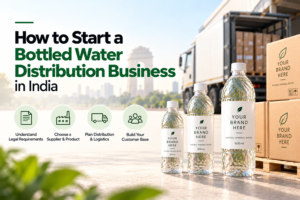
If you are researching how to start a bottled water distribution business in India, this guide covers the essential steps, from market research and supplier selection to profit calculations, inventory planning and commercial due diligence.
1. Understand the Bottled Water Distribution Business Model
A bottled water distributor purchases finished bottled drinking water from a supplier and sells it to retailers, businesses or other customers. The distributor typically manages sales, order coordination, inventory, delivery and payment collection.
Unlike a manufacturer, a distributor does not necessarily produce or process the water. Its primary responsibility is to connect suppliers with customers while maintaining a reliable and commercially viable supply operation.
There are several distribution models to consider.
Retail Distribution
In this model, you supply convenience stores, supermarkets, local shops and other retail outlets. Your business depends on building relationships with retailers, maintaining appropriate inventory and replenishing stock according to sales.
Business-to-Business Distribution
You supply bottled water to hotels, restaurants, cafés, offices and other organisations. These customers may place recurring orders, although their purchasing quantities, delivery schedules and payment terms vary.
Event and Hospitality Supply
You supply bottled water for weddings, conferences, exhibitions and corporate events. Demand can be concentrated around specific dates, making order forecasting and delivery coordination particularly important.
Wholesale Distribution
You supply other businesses that purchase larger quantities for resale or onward distribution. This model requires careful management of wholesale pricing, delivery expenses, customer credit and stock availability.
Before choosing a model, decide which customer segment you can serve most effectively. Your target market will influence the product you source, the investment required and the way you organise deliveries.
2. Research Demand in Your Target Market
Before purchasing inventory, determine whether there is sufficient demand in your intended service area.
Start with a defined territory instead of assuming you can serve an entire city profitably from the beginning. A smaller service area can make customer acquisition, delivery planning and inventory management easier to evaluate.
Research the following:
- Number of potential customers in the area
- Existing bottled water suppliers and competing products
- Typical customer order quantities and purchase frequency
- Customer preferences for price, bottle size and packaging
- Seasonal variations in demand
- Delivery expectations and common supply problems
For example, an area with numerous offices may provide opportunities for recurring workplace supply. A location with many event venues may have demand concentrated around weddings, conferences and other functions.
These are potential opportunities, not guarantees of sales. Validate them by speaking directly with prospective customers.
Speak to Potential Buyers
Ask local businesses about their current purchasing arrangements before investing in stock.
Useful questions include:
- How much bottled water do you purchase each week or month?
- How frequently do you place orders?
- What product specifications and packaging do you require?
- What problems do you experience with your existing supplier?
- What delivery schedules do you need?
- What payment terms do you normally expect?
Record the responses and look for common patterns. This research can help you estimate realistic demand and identify customers whose requirements match your proposed supply model.
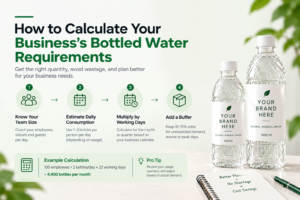
You can also use our guide on calculating your business’s bottled water requirements to estimate potential consumption and prepare more realistic order forecasts.
3. Choose the Right Customer Segment
Trying to serve every type of customer immediately can make a new distribution business difficult to manage. Consider concentrating on one or two segments before expanding.
| Customer segment | Key considerations |
|---|---|
| Retail shops | Sales velocity, retailer margins and replenishment frequency |
| Hotels and restaurants | Consumption volume, product specifications and delivery schedules |
| Corporate offices | Procurement procedures, recurring demand and payment terms |
| Event organisers | Event dates, attendance estimates and delivery coordination |
| Other distributors | Wholesale pricing, order quantities and onward distribution costs |
Choose a segment based on actual demand, customer accessibility and your ability to serve it profitably.
For example, a customer placing a large order may initially seem attractive. However, if that order requires expensive transport, long payment terms or repeated trips to a distant location, the profit contribution may be lower than expected.
Evaluate customers based on their overall commercial value, not just the size of their orders.
4. Find and Evaluate Bottled Water Suppliers
Your supplier affects product availability, purchase costs, documentation, order requirements and the reliability of your business operations.
Avoid choosing a supplier solely because it offers the lowest quoted price. First, establish whether the product and supply arrangement meet your customers’ needs.
Confirm Product Specifications
Ask the supplier to confirm:
- The exact finished drinking water product available
- Bottle sizes and packaging formats offered
- Product labelling and packaging information
- Relevant product and regulatory documentation
- Storage and handling instructions
- Order quantities and repeat-order availability
If you want to distribute bottled water in alternative packaging, clarify the material used and request product-specific documentation.
For example, PLA stands for polylactic acid, a polymer commonly produced from fermented plant-derived sugars or starches. It is used in selected packaging applications, including certain bottle formats.
However, do not assume that every bottled water supplier offers PLA-based products or that all PLA packaging is compostable or biodegradable under every disposal condition.
Review Commercial Terms
Request written information about purchase prices, applicable taxes, transportation charges, minimum order quantities, payment terms and delivery arrangements.
You should also clarify:
- Whether prices remain valid for a specified period
- Whether orders can be replenished regularly
- How damaged or incorrect deliveries are handled
- Whether there are restrictions on resale or distribution
- Whether branding or territory restrictions apply
If a supplier proposes an exclusive territory or special distribution arrangement, request the terms in writing and review the conditions carefully.
Verify Regulatory Requirements
Bottled drinking water is subject to regulatory requirements in India. Before starting operations, verify the requirements that apply to the specific product and your business activity.
Consult the Bureau of Indian Standards and the Food Safety and Standards Authority of India for current standards, licensing information and applicable compliance requirements.
Do not assume that a supplier’s documents automatically cover your own distribution business. Confirm which registrations, licences and obligations apply to your role and operating model.
5. Calculate the Initial Investment
The investment required to start a bottled water distribution business depends on your operating model, order volume, storage arrangements and delivery requirements.
Prepare a cost estimate using actual supplier quotations and local operating costs.
Initial Inventory
Calculate the purchase cost of the stock you intend to hold. Avoid buying more inventory than you can reasonably sell or store simply to obtain a lower unit price.
Storage Expenses
Determine whether you need dedicated storage space or another suitable arrangement. Consider rent, deposits, stock handling, equipment and the supplier’s storage instructions.
Transportation and Delivery
Estimate the cost of moving products from the supplier to your storage location and then to customers.
Include vehicle hire or ownership, fuel, loading and unloading, driver expenses, maintenance and the number of deliveries required.
Business Administration
Budget for applicable registrations, accounting, invoicing, communication, customer acquisition and other operating expenses.
Working Capital
You may need money to pay suppliers before customers settle their invoices. This is especially important if you offer credit or serve customers with long payment cycles.
A simple planning formula is:
Initial capital requirement = Setup costs + Initial inventory + Operating cash reserve
Use realistic assumptions for each component. There is no single investment figure that applies to every distribution business.
6. Calculate Profit Margins and Break-Even Sales
A distribution business can generate substantial sales without necessarily producing attractive profits. The important figure is how much remains after the costs associated with each sale.
Consider this illustrative example:
| Item | Per bottle |
|---|---|
| Purchase cost | ₹10.00 |
| Selling price | ₹13.00 |
| Gross contribution before other costs | ₹3.00 |
| Delivery and handling allocation | ₹1.00 |
| Other variable costs | ₹0.50 |
| Contribution after listed variable costs | ₹1.50 |
These figures are examples only, not actual market prices or a profitability forecast.
In this example, ₹1.50 remains per bottle after the listed variable costs. Fixed expenses such as rent, salaries, administration and financing still need to be deducted.
Use this formula:
Contribution per bottle = Selling price − Purchase cost − Variable costs
You can then estimate monthly contribution:
Monthly contribution = Contribution per bottle × Bottles sold
Calculate Your Break-Even Point
Break-even analysis helps you estimate how many bottles you must sell to cover fixed expenses.
Break-even quantity = Monthly fixed costs ÷ Contribution per bottle
For example, if monthly fixed costs are ₹30,000 and contribution is ₹1.50 per bottle:
₹30,000 ÷ ₹1.50 = 20,000 bottles per month
This is a simplified illustration. Use your actual costs, selling prices and expected order volumes to calculate your own break-even point.
Remember to account for credit periods and delayed customer payments. A large order does not necessarily improve cash flow if you must fund inventory for an extended period before receiving payment.
7. Plan Inventory and Replenishment
Inventory planning helps you balance product availability against the cost of holding stock.
Too little inventory can lead to missed orders. Too much can tie up working capital and increase storage and handling expenses.
A useful starting point is:
Reorder point = Average daily sales × Replenishment lead time + Safety stock
Suppose your business sells 200 bottles per day, the confirmed replenishment lead time is four days and you maintain a reserve of 300 bottles.
Your reorder point would be:
200 × 4 + 300 = 1,100 bottles
In this example, you would begin arranging replenishment when usable inventory approaches 1,100 bottles.
These figures are illustrative. Base your actual calculation on sales records, confirmed supplier lead times, storage capacity and the risk of unexpected demand.
Review stock regularly and track inventory received, stock dispatched, incoming orders, damaged products and slow-moving inventory. Use the supplier’s storage instructions and applicable product requirements when handling stock.
8. Build a Customer Acquisition Process
A successful distribution business needs a repeatable way to find, qualify and retain customers.
Start with a manageable prospect list rather than spending heavily on advertising before validating demand.
Create a Target Customer List
Identify retailers, hotels, restaurants, offices or event organisers in your intended service area. Record their locations, contact details, likely purchasing requirements and current supplier arrangements.
Qualify Potential Buyers
Ask about expected order quantities, product specifications, purchasing frequency, delivery requirements and payment terms.
This helps you focus on prospects whose requirements match the product and supply arrangements you can actually offer.
Prepare a Clear Commercial Proposal
Your proposal should specify the product, available packaging, price, order quantity, delivery terms and payment conditions.
Avoid making unsupported promises about product availability, delivery schedules, exclusivity or environmental benefits.
Track Sales and Repeat Orders
Monitor enquiries, quotations, orders, repeat purchases, contribution per customer and overdue payments.
A large number of enquiries does not automatically indicate a healthy business. Focus on customers who can be served reliably and profitably.
9. Evaluate Alternative Packaging Opportunities
Some buyers may be interested in bottled drinking water supplied in packaging other than conventional PET bottles. This can be relevant when evaluating potential customers in hospitality, corporate procurement, events or retail.
However, packaging preference alone does not guarantee demand. Confirm that prospective customers want the product and that the commercial terms support a viable distribution model.
If you are evaluating PLA-based bottles, request information about material composition, relevant product documentation, storage and handling, environmental claims and disposal guidance.
Avoid describing PLA packaging as universally biodegradable, compostable or environmentally superior without evidence supporting the specific claim.
For additional background, explore the material information and our guide to what happens to a PLA bottle after disposal.
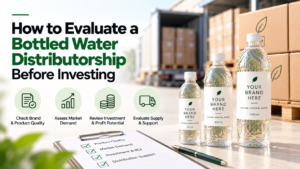
10. Assess a Distribution Opportunity Before Investing
Before committing significant capital, review the complete business proposition.
- Have you validated demand with prospective customers?
- Have you confirmed product specifications and relevant documentation?
- Do you understand the purchase price and all applicable charges?
- Have you calculated contribution after delivery and handling?
- Can you fund inventory while customers pay?
- Have you confirmed minimum order quantities and replenishment lead times?
- Can you store and deliver the product appropriately?
- Have you reviewed resale, branding or territory restrictions?
- Have you verified the applicable regulatory requirements?
- Do you have a plan for repeat orders, slow-moving inventory and customer complaints?
Be particularly cautious about guaranteed earnings, exclusive territories or promises of assured customer demand. Request written evidence and carefully review the conditions before relying on such claims.
A sound decision should be based on validated demand, realistic economics and a clear understanding of the supplier relationship.
11. Explore Finished PLA-Bottled Water Supply with Not A PET Bottle
If your distribution research includes alternatives to conventional PET packaging, Not A PET Bottle may be relevant to your supplier evaluation.
Not A PET Bottle focuses on finished drinking water in PLA-based bottles for businesses exploring alternative bottled water packaging.
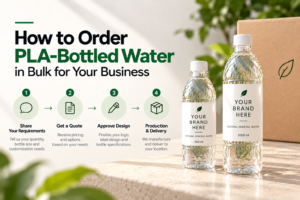
If you are considering a potential bulk supply or distribution arrangement, share your target market, estimated order quantity, intended customer segment and delivery location with the team. This provides a starting point for discussing product availability and commercial requirements.
Distribution arrangements, territories, order quantities, pricing, branding options and delivery feasibility must be confirmed directly. An enquiry does not guarantee that a distributorship or exclusive territory is available.
Explore the packaged drinking water offering, browse the product range, or contact Not A PET Bottle to discuss your requirements.
Frequently Asked Questions
How much investment is needed to start a bottled water distribution business in India?
The investment depends on initial inventory, storage, transportation, operating expenses and working capital. Prepare a budget using supplier quotations and local operating costs before committing capital.
Is bottled water distribution profitable in India?
Profitability depends on purchase costs, selling prices, order volumes, delivery expenses, customer payment terms and fixed costs. Calculate contribution per unit and break-even sales using realistic figures rather than relying on advertised margin estimates.
How do I find bottled water suppliers?
Identify suppliers offering the finished product required by your target customers. Compare product specifications, relevant documentation, pricing, minimum order quantities, delivery arrangements and payment terms. Verify credentials before entering a commercial relationship.
Do I need a licence to distribute bottled drinking water in India?
Applicable registration and licensing requirements depend on your business activities and current regulations. Confirm the requirements for your specific operation with FSSAI and the relevant authorities.
Can I distribute bottled water in PLA-based bottles?
That depends on whether a suitable finished bottled water product and commercial supply arrangement are available. Confirm product availability, packaging documentation, order requirements and delivery terms directly with the supplier.
How do I calculate profit margins on bottled water distribution?
Subtract the purchase cost and variable fulfilment costs from the selling price to calculate contribution per bottle. Deduct fixed operating expenses to estimate operating profit.
Should I purchase inventory before finding customers?
It is generally prudent to validate demand and obtain supplier quotations before committing to substantial inventory. Initial customer conversations can help you estimate order sizes, purchasing frequency and required product specifications.
Does Not A PET Bottle offer distributorships in India?
Distribution availability, territories and commercial arrangements must be confirmed directly. You can share your intended market, estimated demand and business details through the contact page to discuss whether a suitable supply arrangement may be possible.
Final Thoughts
Starting a bottled water distribution business in India requires careful customer research, realistic financial planning and supplier due diligence.
Begin by identifying a specific customer segment, validating demand and calculating the costs of serving it. Then verify product documentation, commercial terms and supply arrangements before committing to inventory.
If you are exploring finished PLA-bottled drinking water as part of your distribution plans, validate customer interest and calculate the economics before investing. A well-researched approach gives you a stronger foundation for building a sustainable distribution operation.