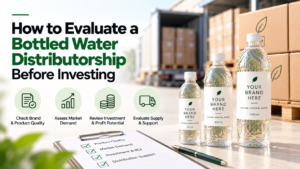
A bottled water distributorship can appear attractive when businesses in your area regularly purchase drinking water. However, before investing in inventory, transport or storage, you need to establish whether the opportunity offers sufficient demand, workable margins and reliable supply arrangements.
The biggest mistake is evaluating a distributorship based only on the supplier’s quoted price or promised sales potential. A more reliable assessment considers the complete business model: who will buy the product, how much they will purchase, what it costs to serve them and how quickly you can recover your investment.
If you are considering a bottled water distributorship in India, this guide explains how to assess suppliers, calculate distribution economics, estimate inventory requirements and conduct commercial due diligence before committing your capital.
1. Understand What the Distributorship Actually Offers
Start by clarifying the proposed business arrangement. The term distributorship can refer to different commercial relationships, so do not assume every supplier offers the same rights, responsibilities or benefits.
Depending on the arrangement, a distributor may purchase finished bottled drinking water and resell it to retailers, hotels, offices, event organisers or other businesses.
Before evaluating an opportunity, establish:
- Which finished drinking water product is being supplied
- Who purchases the product and through which sales channels
- Whether the arrangement includes any territorial restrictions or exclusivity
- What purchase quantities and payment terms apply
- Who manages storage, transportation and customer deliveries
- Whether the distributor is responsible for marketing or customer acquisition
- What support, if any, the supplier provides
Ask the supplier to explain the commercial arrangement in writing. If a proposal includes exclusive territories, guaranteed sales or other special benefits, examine the precise terms and conditions rather than relying on verbal assurances.
The objective is to understand what you are committing to, what the supplier is responsible for and what you must manage independently.
2. Validate Customer Demand Before Investing
A distribution opportunity is only commercially attractive if you can identify customers who are willing to purchase the product at prices that support your operating costs.
Begin by defining your intended service area. Instead of assuming you can sell throughout an entire city, identify a manageable group of potential customers and investigate their purchasing requirements.
Potential customer segments include:
- Retail shops and convenience stores
- Hotels, restaurants and cafés
- Corporate offices and business parks
- Wedding planners and event organisers
- Retailers or businesses purchasing for resale
Each segment has different requirements. Retailers may focus on product movement and resale margins, while hotels may prioritise consistent supply and delivery schedules. Event organisers may need large quantities within a specific timeframe.
Questions to Ask Potential Customers
Speak directly with prospective buyers before placing a substantial inventory order.
Ask:
- How much bottled water do you currently purchase?
- How often do you place orders?
- Which product specifications and packaging formats do you require?
- What do you value most in a supplier?
- Are you satisfied with your current purchasing arrangement?
- What price and delivery terms would you need to consider a new supplier?
Record the answers and distinguish confirmed interest from general expressions of curiosity.
For example, a retailer saying that an alternative product sounds interesting is not the same as a retailer confirming its expected monthly order quantity.
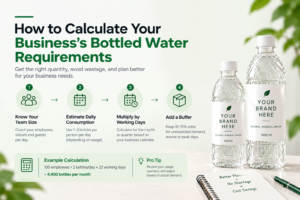
You can use the framework in our guide to calculating your business’s bottled water requirements to estimate the potential demand represented by your prospective customers.
3. Evaluate the Supplier Carefully
The supplier determines the product you can offer, the price you pay, the documentation available and the reliability of your supply.
Request sufficient information to assess both the product and the commercial relationship.
Confirm the Product Specifications
Ask for details about:
- The finished drinking water product
- Available bottle sizes and packaging formats
- Product labelling and specifications
- Relevant product and regulatory documentation
- Storage and handling requirements
- Order availability and replenishment arrangements
If you are evaluating alternative packaging, verify the material used in the actual finished product rather than relying on general marketing descriptions.
For example, PLA stands for polylactic acid, a polymer commonly produced from fermented plant-derived sugars or starches. It is used in selected packaging applications, including certain bottle formats.
However, do not assume that every bottled water supplier offers PLA-based packaging or that all PLA products are compostable or biodegradable under every disposal condition.
Review Supply Reliability
Ask how orders are confirmed, what happens if a product is temporarily unavailable and how delivery delays are communicated.
For a distributor, supply interruptions can affect customer relationships, particularly when serving businesses with recurring requirements.
Request realistic delivery estimates and clarify the supplier’s process for handling shortages, damaged products and incorrect deliveries.
Check Commercial Terms
Obtain written details covering purchase prices, applicable taxes, transport charges, payment terms, minimum order quantities and any additional fees.
Also establish whether the quoted price is valid for a specified period and how changes in commercial terms will be communicated.
A supplier offering a lower purchase price may not be the better choice if transport expenses, order restrictions or supply uncertainty make the overall arrangement less attractive.
4. Calculate the Real Cost of Distribution
Before investing, calculate how much it costs to deliver each unit to a customer.
Consider an illustrative example:
| Cost component | Per bottle |
|---|---|
| Purchase price | ₹10.00 |
| Transportation and handling | ₹1.00 |
| Other variable costs | ₹0.50 |
| Total variable cost | ₹11.50 |
| Selling price | ₹13.00 |
| Contribution per bottle | ₹1.50 |
These figures are examples only. They are not actual prices, margins or commercial terms offered by any supplier.
In this example, the contribution is ₹1.50 per bottle before fixed operating expenses such as rent, salaries, administration and financing.
Use this formula:
Contribution per bottle = Selling price − Purchase cost − Variable distribution costs
Your variable costs should reflect the actual way you operate. Include loading, unloading, delivery expenses and other costs directly associated with fulfilling orders.
For deliveries involving several customers, estimate transport costs across the route rather than assuming every delivery has the same cost.
Compare Different Customer Orders
Consider two prospective customers:
- Customer A places a smaller order but is located close to your storage facility.
- Customer B places a larger order but requires a longer journey and additional handling.
Customer B may generate more revenue, but the larger order does not automatically produce more profit.
Calculate the contribution after fulfilment costs for each customer. This helps you identify which orders support your business rather than simply increasing sales volume.
5. Calculate the Break-Even Point
Your distributorship must generate enough contribution to cover its fixed expenses.
Break-even analysis estimates the quantity you need to sell before the business covers those costs.
Break-even units = Monthly fixed costs ÷ Contribution per unit
For example, if monthly fixed expenses are ₹30,000 and the contribution is ₹1.50 per bottle:
₹30,000 ÷ ₹1.50 = 20,000 bottles per month
This simplified example assumes the same contribution for every bottle and excludes changes in sales mix or other financial factors.
Use your own supplier quotation, expected selling prices and operating expenses to calculate a realistic break-even figure.
Then ask whether the customers you have identified can reasonably support that sales volume. If the required volume is significantly higher than the demand you have validated, reconsider the scale of your initial investment.
6. Assess Working Capital and Payment Terms
A distributorship can face cash-flow problems even when sales appear healthy.
You may need to pay the supplier before selling the inventory or before customers pay their invoices. If you offer credit to retailers or business customers, the gap between outgoing and incoming payments can become particularly important.
Before investing, estimate:
- The initial inventory purchase
- Expected time between paying the supplier and receiving customer payments
- Recurring transport and operating expenses
- The value of stock likely to remain unsold
- The funds needed to place repeat orders
Review customer credit terms carefully. A large customer with delayed payments may create more financial pressure than a smaller customer who pays promptly.
Avoid committing all available capital to initial inventory. Retaining a suitable operating reserve can help manage unexpected expenses and replenishment requirements.
7. Evaluate Inventory and Storage Requirements
Inventory should reflect expected demand, supplier lead times and your ability to store and deliver products appropriately.
Too little stock may cause missed orders. Too much inventory ties up cash and increases handling requirements.
Start by estimating sales during the time required to replenish stock.
A basic reorder-point formula is:
Reorder point = Average daily sales × Replenishment lead time + Safety stock
Suppose you expect to sell 200 bottles per day, replenishment takes four days and your chosen reserve is 300 bottles.
200 × 4 + 300 = 1,100 bottles
In this example, you would begin arranging replenishment when usable stock approaches 1,100 bottles.
The figures are illustrative. Use confirmed supplier lead times and actual sales patterns to set your own reorder point.
Also consider storage capacity, transport arrangements and the supplier’s handling instructions. Keep appropriate records of stock received, stock dispatched, damaged products and remaining inventory.
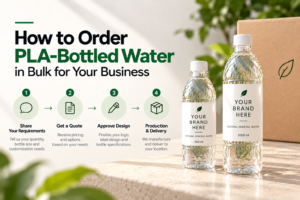
For a practical overview of the ordering process, see our guide to ordering PLA-bottled water in bulk.
8. Check the Regulatory and Documentation Requirements
Before starting distribution, determine which regulatory obligations apply to your business activity and the product you intend to sell.
Bottled drinking water is subject to regulatory requirements in India. Verify the current requirements with the Food Safety and Standards Authority of India and the Bureau of Indian Standards.
Ask the supplier for relevant product documentation and verify that it corresponds to the actual product being supplied.
Also confirm which registrations or licences apply to your own distribution operation. Requirements may depend on your activities and the current regulatory framework.
Do not assume that a supplier’s documentation automatically covers your business, and avoid making product or environmental claims that are not supported by relevant evidence.
9. Investigate Territory, Exclusivity and Other Contract Terms
If a supplier proposes a distribution agreement, read the complete terms before making a financial commitment.
Important points include:
- Whether the arrangement is exclusive or non-exclusive
- The geographical area covered, if any
- Any sales targets or purchase commitments
- Payment deadlines and penalties
- Price revision conditions
- Rules for resale and customer relationships
- Conditions for termination or renewal
- Responsibility for damaged goods and customer complaints
If a proposal includes exclusivity, clarify what happens if the supplier cannot fulfil orders or if the agreed sales targets cannot be met.
Do not pay an upfront fee or purchase substantial inventory solely because someone promises guaranteed returns, a protected territory or assured customers. Request written evidence and independently assess the commercial terms.
A sound decision depends on verifiable demand and realistic financial projections, not just the attractiveness of the proposal.
10. Evaluate Alternative Packaging as a Business Opportunity
Some business buyers may be interested in drinking water supplied in packaging other than conventional PET bottles. This can be relevant when exploring opportunities with hospitality businesses, corporate buyers, event organisers or retailers.
However, alternative packaging does not automatically guarantee a higher selling price or stronger demand. Validate customer interest and determine whether the product’s specifications and commercial terms fit your market.
If you are considering PLA-based bottles, ask for information about the actual packaging material, relevant documentation, storage and handling requirements, and disposal guidance.
You can explore our page about PLA bottles in India for additional packaging context. This information should not be interpreted as an offer to sell empty bottles or raw materials.
For distribution planning, the relevant question is whether suitable finished drinking water in PLA-based bottles is available under commercial terms that work for your intended customers.
11. Discuss Your Requirements with Not A PET Bottle
Not A PET Bottle focuses on finished drinking water in PLA-based bottles for businesses exploring alternative bottled water packaging.
If you are assessing a potential distribution or bulk-supply opportunity, share your target customer segment, intended service area, estimated order quantity and delivery requirements with the team.
This provides a starting point for discussing product availability and relevant commercial terms. Pricing, minimum order quantities, branding options, delivery feasibility and distribution arrangements must be confirmed directly.
A discussion does not guarantee that a distributorship, exclusive territory or specific commercial arrangement is available.
Explore the packaged drinking water offering, browse the product range, or contact the team to discuss your business requirements.
Frequently Asked Questions
What should I check before investing in a bottled water distributorship?
Evaluate customer demand, supplier reliability, product documentation, purchase and selling prices, delivery expenses, inventory requirements, working capital and contractual terms. Validate demand before committing to substantial inventory.
How do I calculate profit from a bottled water distributorship?
Subtract the purchase price and variable fulfilment costs from the selling price to calculate contribution per unit. Then deduct fixed expenses to estimate operating profit. Use actual quotations and realistic sales estimates rather than assumed margins.
How much inventory should a distributor maintain?
Inventory should cover expected sales during the replenishment period, plus an appropriate reserve based on demand variability and supply risk. Consider storage capacity, available working capital and confirmed supplier lead times.
What questions should I ask a bottled water supplier?
Ask about product specifications, relevant documentation, purchase prices, minimum order quantities, payment terms, delivery arrangements, replenishment, damaged deliveries and any restrictions on resale or territory.
Can I distribute PLA-bottled drinking water in India?
That depends on the availability of a suitable finished drinking water product and the commercial supply arrangement. Confirm product specifications, documentation, applicable requirements and supply terms with the supplier.
Does Not A PET Bottle currently offer a distributorship?
Distribution opportunities, territories and commercial arrangements must be confirmed directly with Not A PET Bottle. You can share your business details and estimated demand through the contact page to discuss whether a suitable arrangement may be possible.
Final Thoughts
Evaluating a bottled water distributorship requires more than comparing supplier prices. You need to validate customer demand, calculate the contribution after delivery costs, understand working-capital requirements and verify the product and contract terms.
Before investing, prepare realistic financial projections based on actual supplier quotations and customer research. If you are exploring finished PLA-bottled drinking water, confirm product availability and commercial requirements before making inventory commitments.