Choosing sustainable bottled water packaging requires more than trusting labels such as eco-friendly, plant-based, biodegradable, or compostable. Businesses need to understand what these claims mean, what evidence supports them, and whether the packaging can be managed appropriately after use.
For restaurants, cafés, corporate offices, and hospitality businesses, packaging decisions affect purchasing costs, waste management, and brand credibility. Unsupported environmental claims can create confusion for customers and undermine sustainability commitments.
Before purchasing packaged water, procurement teams should examine material composition, relevant test reports, certifications, and disposal requirements rather than relying solely on marketing language.
This guide explains how to verify environmental claims, understand common packaging labels, and assess suppliers using a practical checklist.
1. Why Businesses Should Verify Packaging Claims
Environmental claims increasingly influence purchasing decisions, especially for businesses with sustainability policies or environmental reporting requirements.
However, two packages described as sustainable may have different material compositions, processing requirements, and disposal options.
For example, a bottle made from plant-derived material is not automatically biodegradable in ordinary surroundings. Similarly, compostable packaging may require controlled processing conditions that are unavailable through local waste-management systems.
Before approving a packaging option, procurement teams should establish:
- What materials are used in the bottle and its components.
- What environmental benefit the supplier claims.
- Whether the claim applies to the entire package or only one component.
- What testing or documentation supports the claim.
- Under what conditions the claimed benefit can be achieved.
- Whether suitable recycling or composting facilities are available.
Businesses evaluating Not A PET Bottle and its NPB-PLA™ packaged bottled water should apply the same verification process used for any packaging supplier.
2. Understand Recyclable, Biodegradable, and Compostable Packaging
These terms describe different characteristics and should not be treated as interchangeable.
Recyclable Packaging
Recyclable packaging can be processed into recovered material for further use. However, actual recycling depends on material compatibility, collection systems, sorting facilities, and local infrastructure.
Ask suppliers which components are recyclable, whether local facilities accept them, and whether caps or labels need to be separated.
A material may be technically recyclable without being collected or recycled in every location.
Biodegradable Packaging
Biodegradable materials can be broken down by microorganisms under suitable conditions. The process and timeframe depend on the material and its environment.
Ask whether the claim relates to soil, freshwater, marine environments, or controlled processing conditions. Evidence for one environment should not automatically be applied to another.
Compostable Packaging
Compostable packaging is designed to break down under specified composting conditions and meet applicable criteria for the resulting material.
Some materials require industrial composting facilities with controlled temperature, moisture, and processing time. They may not break down similarly in a home compost bin, landfill, or natural environment.
Businesses should confirm the type of composting required and whether appropriate facilities are accessible.
Read more about compostable, biodegradable, and recyclable packaging.
3. Check the Actual Material Composition
Environmental claims should be evaluated against the composition of the complete package, not just the bottle body.
A bottled water product may include a bottle, cap, label, adhesive, ink, and secondary packaging. Each component can have different material and disposal requirements.
Ask suppliers for details about:
- Bottle body: Primary material, blends, and relevant additives.
- Cap and closure: Material composition and compatibility with disposal systems.
- Label and adhesive: Materials used and their effect on recycling or composting.
- Secondary packaging: Composition of cartons, wrapping, and shipping materials.
- Material origin: Whether renewable or plant-derived claims apply to the entire component or only a portion.
- Disposal instructions: Recommended treatment for each relevant component.
Understand PLA-Based Packaging
PLA, or polylactic acid, is a polymer commonly produced from renewable plant-derived feedstocks. Its characteristics depend on material formulation, product design, manufacturing, and intended application.
Plant-derived origin does not automatically establish that packaging will biodegrade in ordinary surroundings or can be processed through conventional plastic recycling systems.
Businesses considering NPB-PLA™ packaged bottled water can read the What Is PLA? guide to understand the material category.
The important question is whether the specific packaging performs as claimed under the conditions described by the supplier.
4. Verify Testing Reports and Certifications
A supplier’s environmental claims should be supported by evidence appropriate to the specific statement.
A product brochure may describe the intended environmental benefits, but it does not necessarily establish that the material meets a particular technical standard.
Depending on the claim, request:
- Material specifications and composition information.
- Relevant test reports.
- Applicable certifications from recognized certification bodies.
- The testing standard or method used.
- Details of testing conditions and duration.
- Identification of the component or product tested.
- Disposal instructions explaining the conditions required to achieve the stated result.
Check What the Evidence Proves
A certification covering the bottle body does not necessarily establish that the cap, label, and complete package meet the same standard.
Similarly, evidence of biodegradation under controlled conditions does not prove that the material will break down quickly in the open environment.
Check the issuing organization, certification scope, testing conditions, and relevance to the supplied product.
If documentation is incomplete, ask the supplier for clarification before using the claim in purchasing decisions or sustainability communications.
5. Confirm Disposal Conditions and Local Infrastructure
Packaging performance after use depends partly on the available disposal route.
Before selecting packaging, ask:
- Is the material accepted by local recycling facilities?
- Does it require industrial composting?
- Are suitable processing facilities accessible?
- Must different components be separated?
- What happens if the package enters general waste?
- Can the supplier provide clear disposal instructions?
A compostable package may not achieve its intended end-of-life outcome if it enters a waste stream that cannot process it appropriately. Likewise, recyclable packaging may not be recycled where collection systems do not accept the material.
For PLA-based packaging, the required processing conditions depend on the formulation, product design, and waste-management route.
Read What Happens to a PLA Bottle After You Throw It Away? for additional information about end-of-life considerations.
6. Look Beyond Environmental Marketing Language
Words such as green, natural, sustainable, and eco-friendly are broad descriptions. On their own, they do not establish a measurable environmental benefit.
Use this process to evaluate supplier statements:
- Identify the claim: Determine whether it concerns renewable material origin, recyclability, biodegradability, compostability, or another benefit.
- Request evidence: Ask for relevant specifications, test reports, or certifications.
- Check the scope: Confirm whether the evidence covers one component or the complete package.
- Verify the conditions: Understand the environment, timeframe, and infrastructure required.
- Assess practical suitability: Determine whether the recommended disposal route is available to your business.
Where a claim cannot be substantiated, avoid repeating it in menus, advertisements, procurement documents, or sustainability reports as an established fact.
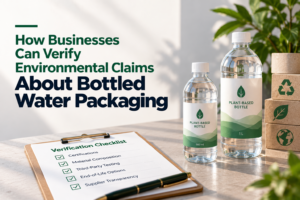
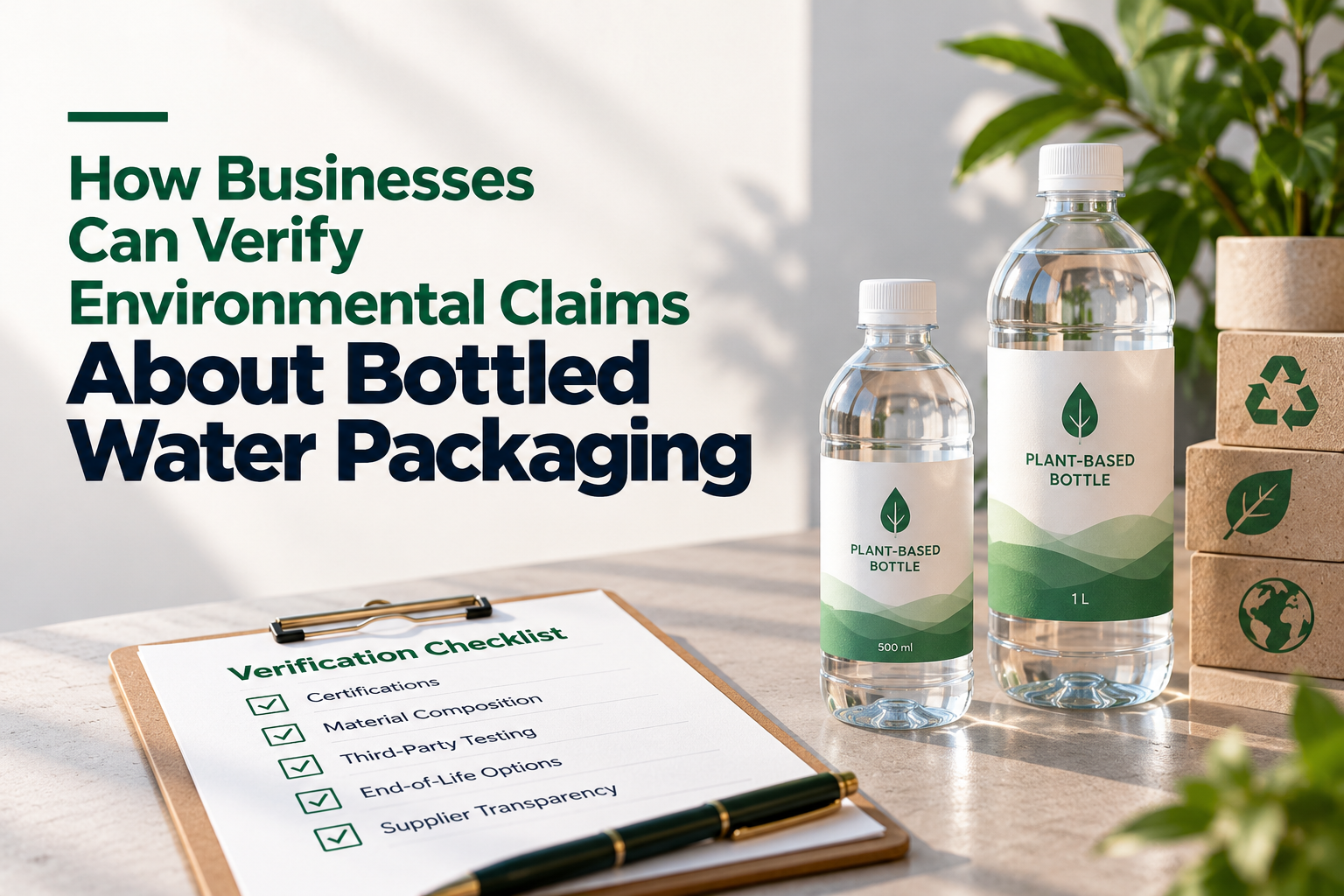
7. Environmental Claims Verification Checklist
Use this checklist when evaluating bottled water packaging suppliers.
Material and Documentation
- Bottle and component materials are identified.
- Plant-derived material claims specify what they cover.
- Relevant material specifications are available.
- Test reports support the specific environmental claims.
- Certifications can be independently verified.
- Testing conditions and limitations are explained.
Disposal and Environmental Suitability
- Recyclability claims match the intended local recycling system.
- Compostability claims specify the required conditions.
- Suitable disposal facilities are available.
- Staff and customers can receive accurate disposal instructions.
Supplier Evaluation
- Environmental claims are specific and evidence-based.
- Documentation corresponds to the actual packaging.
- Unsupported claims are not repeated in business marketing.
- Packaging meets operational and purchasing requirements.
- Outstanding questions are resolved before approval.
A supplier that answers these questions clearly makes it easier to document purchasing decisions and assess environmental claims responsibly.
8. Evaluate NPB-PLA™ Packaged Bottled Water
Businesses exploring alternatives to conventional packaging can consider NPB-PLA™ packaged bottled water from Not A PET Bottle as part of their supplier evaluation.
Review the available material and product information, identify the environmental claims relevant to your requirements, and request appropriate supporting documentation.
Consider the product specifications, material composition, applicable testing, recommended disposal conditions, order quantities, and delivery arrangements.
The objective is to evaluate the actual product against your procurement criteria rather than make assumptions based solely on its material name.
Visit Not A PET Bottle to learn more about the offering, or contact the team to discuss product specifications and business purchasing requirements.
Conclusion
Verifying environmental claims about bottled water packaging helps businesses make informed purchasing decisions and communicate sustainability commitments responsibly.
Recyclable, biodegradable, and compostable describe different characteristics. None should be accepted as a blanket guarantee without checking material composition, supporting evidence, applicable conditions, and available disposal infrastructure.
For businesses evaluating sustainable bottled water packaging, the most reliable approach is to identify the exact claim, request relevant documentation, verify what the evidence covers, and determine whether the recommended end-of-life process is practical.
A consistent verification process helps procurement teams assess suppliers more confidently, reduce the risk of unsupported environmental claims, and select packaging aligned with their operational requirements and documented sustainability objectives.