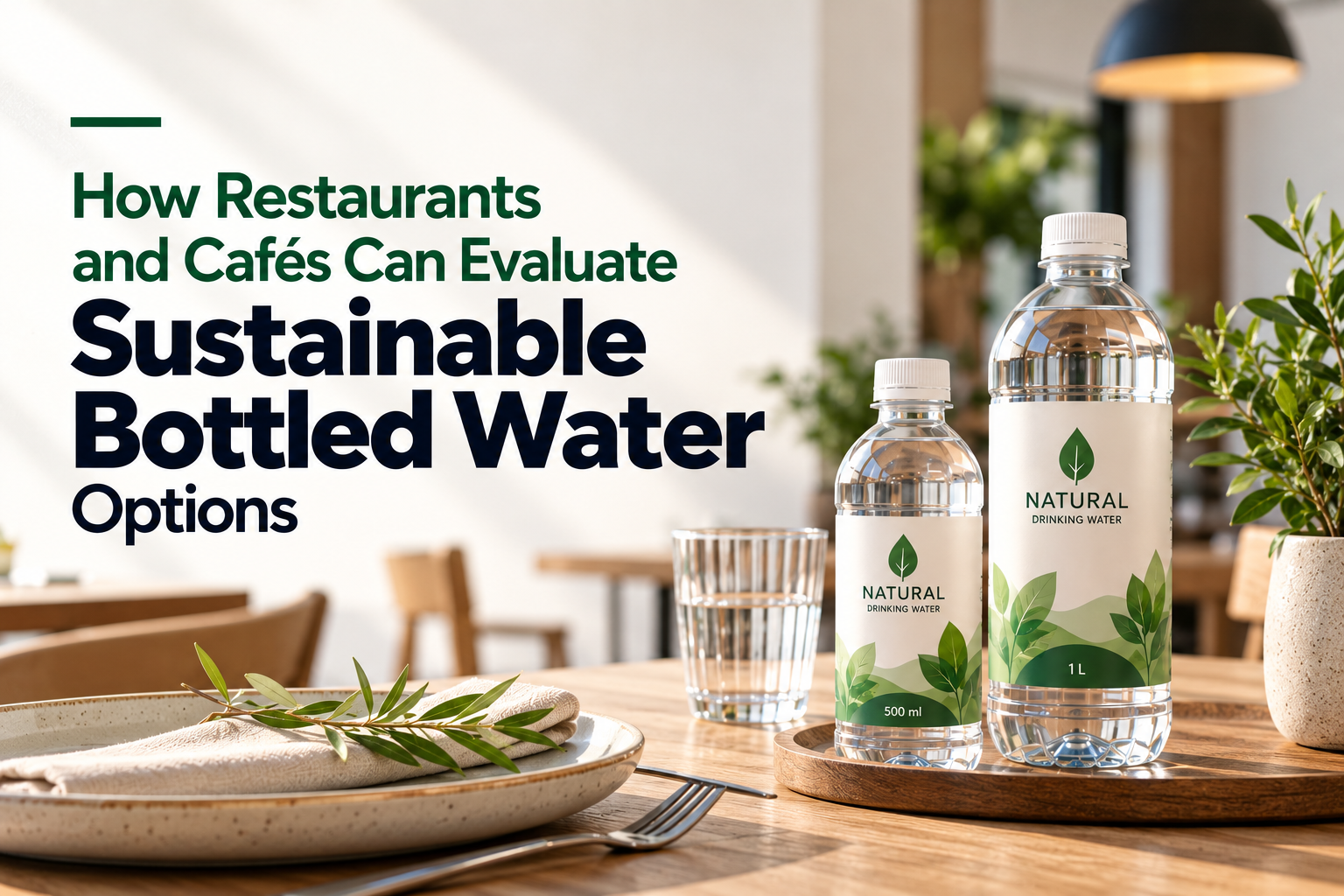
Choosing sustainable bottled water for restaurants involves balancing customer expectations, product presentation, purchasing costs, and daily operations. Restaurants and cafés need bottled water that suits their service style, meets customer expectations, and remains available during busy periods.
The right choice depends on bottle size, customer traffic, packaging material, storage capacity, delivery schedules, and supplier reliability. A premium café may prioritize presentation, while a high-volume restaurant may focus on cost per bottle and consistent stock availability.
Businesses exploring alternative packaging can consider Not A PET Bottle and its NPB-PLA™ packaged bottled water as part of their purchasing evaluation.
This guide explains how restaurant owners, café operators, and food-service businesses can estimate demand, compare packaging options, manage inventory, and evaluate suppliers.
1. Choose the Right Bottle Size for Your Customers
Bottle size affects customer convenience, menu pricing, storage requirements, and purchasing costs. Before selecting a product, consider how customers typically order water at your establishment.
- Small bottles: Suitable for individual servings, takeaway orders, and quick-service dining.
- Medium-sized bottles: Useful for customers who prefer a larger serving without ordering a full-size bottle.
- Large bottles: May suit family dining, shared tables, and longer meals, depending on availability.
- Branded bottled water: Can create a consistent presentation across dine-in service, takeaway orders, and special events.
The appropriate size depends on customer preferences and available product formats.
Match Packaging With Your Restaurant’s Image
Packaging contributes to the overall dining experience. A bottle served at a premium restaurant creates a different impression from one supplied with a takeaway meal.
Consider whether the bottle design, label, and material complement your restaurant’s interiors, menu, and customer expectations.
Businesses exploring alternatives to conventional packaging can review sustainable water bottle options in India.
Before choosing a packaging format, confirm its specifications, handling requirements, and suitability for your service environment.
2. Estimate Your Restaurant’s Bottled Water Requirements
Accurate demand estimates help prevent stockouts without tying up unnecessary money in inventory.
Unlike offices with relatively predictable consumption, restaurants and cafés experience fluctuations based on table occupancy, weekends, weather, special events, and seasonal demand.
Calculate Expected Consumption
Start with three figures:
- Average customers served per day.
- Percentage of customers expected to purchase bottled water.
- Average number of bottles purchased per customer ordering water.
Use this formula:
Daily bottle demand = Daily customers × Purchase rate × Average bottles per purchasing customer
For example, a café serving 150 customers daily may estimate that 40% purchase bottled water, with each purchasing customer ordering one bottle.
150 × 40% × 1 = 60 bottles per day.
Across 30 operating days, that equals approximately 1,800 bottles per month.
This is an illustrative calculation. Use your own sales records wherever possible.
Plan for Peak Demand
Average consumption alone may not be enough. Review demand during weekends, holidays, local events, promotional campaigns, and periods of increased customer traffic.
Maintain a reasonable stock buffer based on your sales patterns and supplier lead times. Excessive inventory can create storage problems, while insufficient stock can lead to missed sales and emergency purchases.
3. Compare Packaging Options for Restaurant Use
Restaurants should evaluate packaging based on more than appearance or material origin. The bottle must suit the intended use, storage conditions, customer expectations, and available disposal arrangements.
| Factor | PLA-based bottles | Conventional PET bottles | Glass bottles |
|---|---|---|---|
| Presentation | Depends on design and labelling | Available in many designs | Often used for premium service |
| Handling | Depends on product specifications | Generally lightweight and resistant to breakage | Heavier and more fragile |
| Storage | Follow supplier guidance | Generally convenient for standard storage | Requires careful handling |
| End-of-life | May require suitable composting infrastructure | Depends on local recycling systems | Reuse or recycling depends on local arrangements |
| Cost | Depends on supplier and order volume | Depends on specifications and volume | Depends on design and supply model |
These are general comparisons. Actual performance depends on bottle design, transportation, handling, and local waste-management infrastructure.
Understand PLA Packaging
PLA is commonly produced from renewable plant-derived feedstocks. However, plant-based origin alone does not establish that a bottle will biodegrade in every environment or can be processed through conventional recycling systems.
Restaurants considering PLA-based packaging should ask about material composition, relevant documentation, handling requirements, and appropriate disposal arrangements.
Review the NPB-PLA™ material information when evaluating packaging specifications.
Choose packaging based on documented characteristics and realistic disposal options rather than broad environmental claims.
4. Manage Storage and Reordering
Restaurant storage areas are often limited. Bottled water must fit within available space without interfering with food storage, staff movement, or other supplies.
Before choosing a supplier, check:
- Available storage space for cartons.
- Refrigerator capacity for chilled bottles.
- Carton dimensions and stacking requirements.
- Recommended storage conditions.
- Ease of moving stock to service areas.
- Shelf-life requirements and stock rotation procedures.
Use a first-in, first-out approach where appropriate, following product storage instructions and expiry requirements.
Set a Reorder Point
A simple reorder system can prevent stockouts.
Reorder point = Daily consumption × Supplier lead time + Safety stock
For example, if a restaurant uses 60 bottles daily, the supplier’s lead time is three days, and the restaurant maintains 100 bottles as safety stock:
60 × 3 + 100 = 280 bottles.
When inventory approaches 280 bottles, review whether a replenishment order is needed.
Adjust the threshold when customer traffic changes or delivery schedules become less predictable.
5. Compare Supplier Prices and Delivery Arrangements
A low quoted price may not be the most economical option if delivery charges, minimum order quantities, or emergency purchases increase the total cost.
When comparing suppliers, request clear information about:
- Price per bottle for the required size.
- Applicable taxes.
- Delivery and transportation charges.
- Minimum order quantity.
- Expected delivery lead time.
- Delivery frequency and serviceable locations.
- Procedures for handling damaged or missing products.
Calculate the effective cost per bottle by dividing the total delivered order cost by the number of bottles received.
For restaurants with multiple outlets, compare total costs across all locations rather than evaluating each delivery separately.
Also assess whether the supplier can accommodate higher demand during weekends, holidays, and busy dining periods.
6. Check Product Quality and Documentation
Before introducing a bottled water product, restaurants should confirm that it meets their requirements and is supported by relevant documentation.
Depending on the product category and applicable regulations, request:
- Applicable food business and manufacturing licences.
- Product specifications and water quality test reports.
- Required label declarations.
- Batch identification and traceability information.
- Shelf-life and storage instructions.
- Supporting evidence for packaging and environmental claims.
Confirm that the documents relate to the specific product being supplied and meet applicable requirements.
For PLA-based packaging, understand the evidence behind claims such as plant-based or compostable before using them in your own marketing.
7. Questions to Ask Before Choosing a Supplier
Use this checklist when evaluating bottled water suppliers.
- Which bottle sizes and water categories are available?
- Does the product suit our service and presentation requirements?
- What is the minimum order quantity?
- What is the total delivered cost, including taxes and transportation?
- How quickly can repeat orders be delivered?
- Can deliveries fit our storage capacity and operating hours?
- What happens if a delivery is delayed or products arrive damaged?
- Can the supplier accommodate peak demand?
- What product specifications and compliance documents are available?
- What evidence supports the packaging’s environmental claims?
- What storage and disposal guidance should we follow?
Compare suppliers using the same criteria to identify an option that fits your restaurant’s operational needs.
8. Consider NPB-PLA™ Packaged Bottled Water
Restaurants and cafés exploring alternative packaging can consider NPB-PLA™ packaged bottled water from Not A PET Bottle as part of their purchasing evaluation.
Before making a decision, discuss your expected demand, required bottle formats, delivery location, product specifications, and replenishment requirements with the supplier.
Visit Not A PET Bottle to learn more about the product offering and its packaging approach.
Conclusion
Selecting sustainable bottled water for restaurants requires a balance between customer experience, packaging suitability, inventory management, purchasing costs, and supplier reliability.
Estimate demand using actual sales patterns, choose bottle sizes that suit your service style, and establish reorder points that prevent unnecessary stockouts. Packaging decisions should also account for documented material specifications and realistic end-of-life options.
For businesses evaluating NPB-PLA™ packaged bottled water, contact Not A PET Bottle to discuss product requirements, expected quantities, and delivery arrangements.
A well-planned purchasing process helps restaurants maintain reliable bottled water availability while making informed decisions about cost, presentation, and packaging.