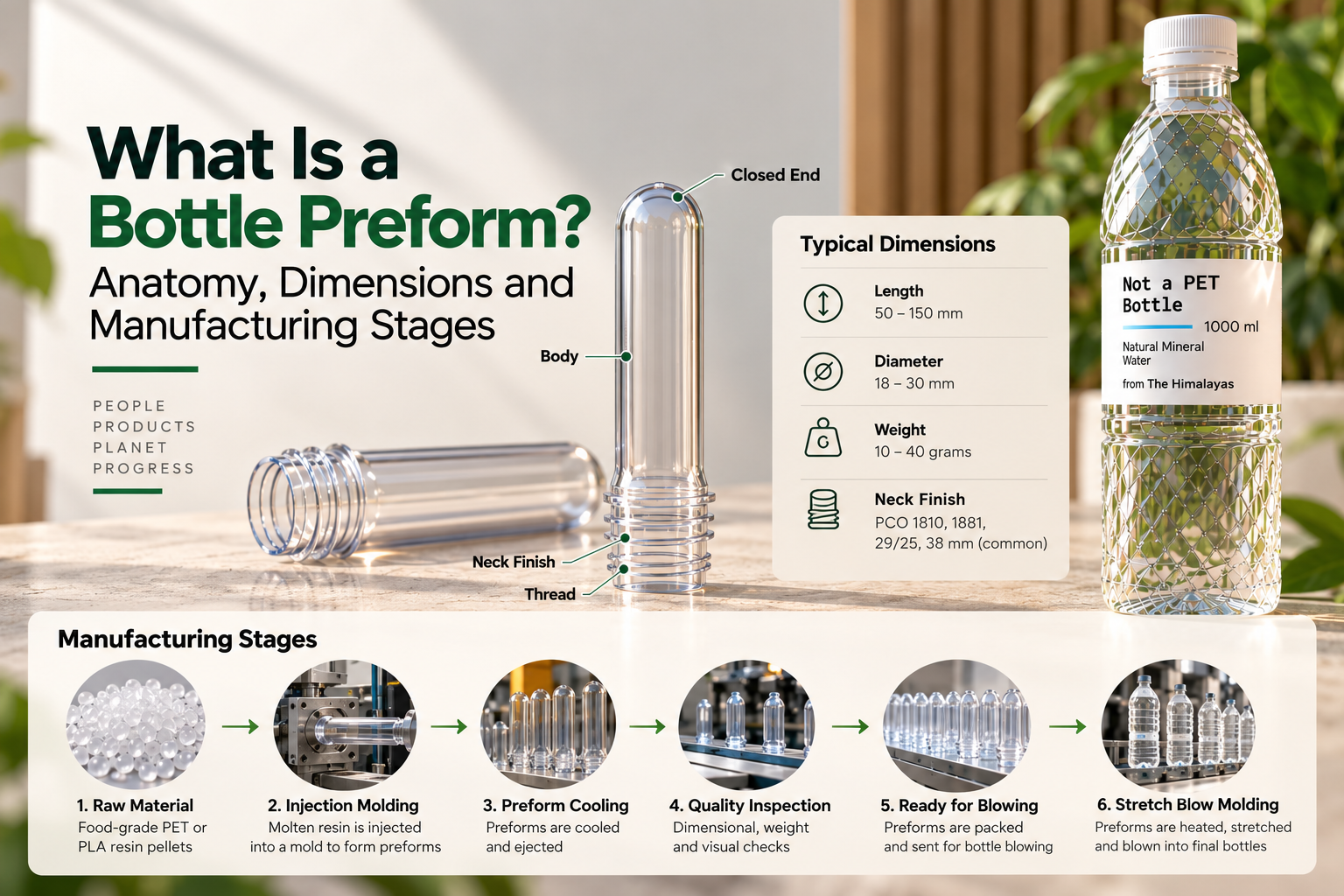
A bottle preform is a small, moulded component that is heated and shaped into a finished bottle. It resembles a test tube with a threaded neck and a thicker body. Preforms are commonly used in PET bottle manufacturing, where they are expanded into their final shape through a process called stretch blow moulding.
Understanding bottle preforms helps businesses evaluate packaging design, material compatibility, production requirements and supplier specifications.
What Does a Bottle Preform Look Like?
A typical bottle preform has three main parts:
- Neck finish: Contains the threads or features needed to fit a cap.
- Body: The cylindrical section that expands to form the bottle.
- Base: The closed end that becomes the bottom of the finished bottle.
The neck usually retains its shape during bottle formation, while the body expands inside a mould.
What Are the Important Dimensions of a Bottle Preform?
Preform specifications vary depending on the bottle design and intended application. Key measurements include:
| Specification | Why It Matters |
|---|---|
| Length | Influences the bottle’s height and design |
| Body diameter | Affects material distribution during expansion |
| Neck finish | Determines cap compatibility |
| Weight | Influences material usage and bottle design |
| Wall thickness | Affects how material stretches during forming |
| Base design | Helps determine the finished bottle’s bottom structure |
There is no single standard preform size for every bottle. Specifications must match the intended bottle shape, capacity, material and manufacturing process.
How Is a Bottle Preform Manufactured?
Bottle preforms are commonly produced through injection moulding.
1. Material preparation: The selected material is prepared according to its processing requirements.
2. Injection moulding: The material is heated and injected into a preform mould.
3. Cooling: The moulded preform cools until it can retain its shape.
4. Ejection and inspection: The preform is removed and checked for visible defects and dimensional consistency.
5. Bottle formation: During stretch blow moulding, the preform is reheated as required, stretched and expanded inside a bottle-shaped mould.
The resulting bottle takes the shape of the mould while the neck finish generally remains unchanged.
Why Does Preform Weight Matter?
Preform weight affects material consumption and influences how material is distributed across the finished bottle. However, a heavier preform does not automatically mean a better bottle.
The right specification depends on the bottle’s intended use, shape, performance requirements and manufacturing conditions. Businesses should evaluate the complete packaging design rather than choosing a preform by weight alone.
Are All Bottle Preforms Made From the Same Material?
No. Material selection depends on the packaging application and the forming process. PET preforms are widely used for conventional plastic bottles, but other packaging materials may require different manufacturing methods.
For businesses exploring alternatives to conventional plastic packaging, Not A PET Bottle offers information on plant-based packaging materials and PLA bottle applications.
Explore our bottle material specifications to understand the material behind our packaging approach, or learn more about PLA bottles for commercial applications.
Important: PLA packaging should not automatically be treated as interchangeable with PET. Processing requirements, product compatibility and end-of-life conditions need to be assessed for the specific application.
How Do You Evaluate a Bottle Preform?
Before approving a preform or packaging sample, check:
- Whether the neck finish matches the intended closure.
- Whether the dimensions align with the bottle design.
- Whether the weight and material distribution meet the application requirements.
- Whether the sample has visible defects or inconsistencies.
- Whether the material and manufacturing process suit the intended product.
For commercial packaging projects, confirm specifications and production compatibility with the relevant supplier before placing an order.
Frequently Asked Questions
What is a bottle preform used for?
A bottle preform is used as the starting component for manufacturing bottles through a suitable forming process, commonly stretch blow moulding for PET bottles.
Is a preform the same as a finished bottle?
No. A preform is an intermediate component. It must undergo a forming process to become the finished bottle.
Can every bottle be made using a preform?
No. The process depends on the material and manufacturing method. Not all bottle types use preforms.
Does Not A PET Bottle sell bottle preforms?
For specific preform availability, manufacturing compatibility or custom requirements, contact Not A PET Bottle directly to discuss your packaging application.
Conclusion
A bottle preform is an important starting point in bottle manufacturing. Its neck finish, dimensions, weight and material all influence the final packaging design.
If your business is exploring alternatives to conventional plastic bottles, visit Not A PET Bottle to learn about our plant-based packaging approach and explore whether our PLA bottle solutions suit your commercial requirements.