Injection moulding and blow moulding are two important processes used in plastic manufacturing. Although they are often discussed together in bottle production, they perform different functions.
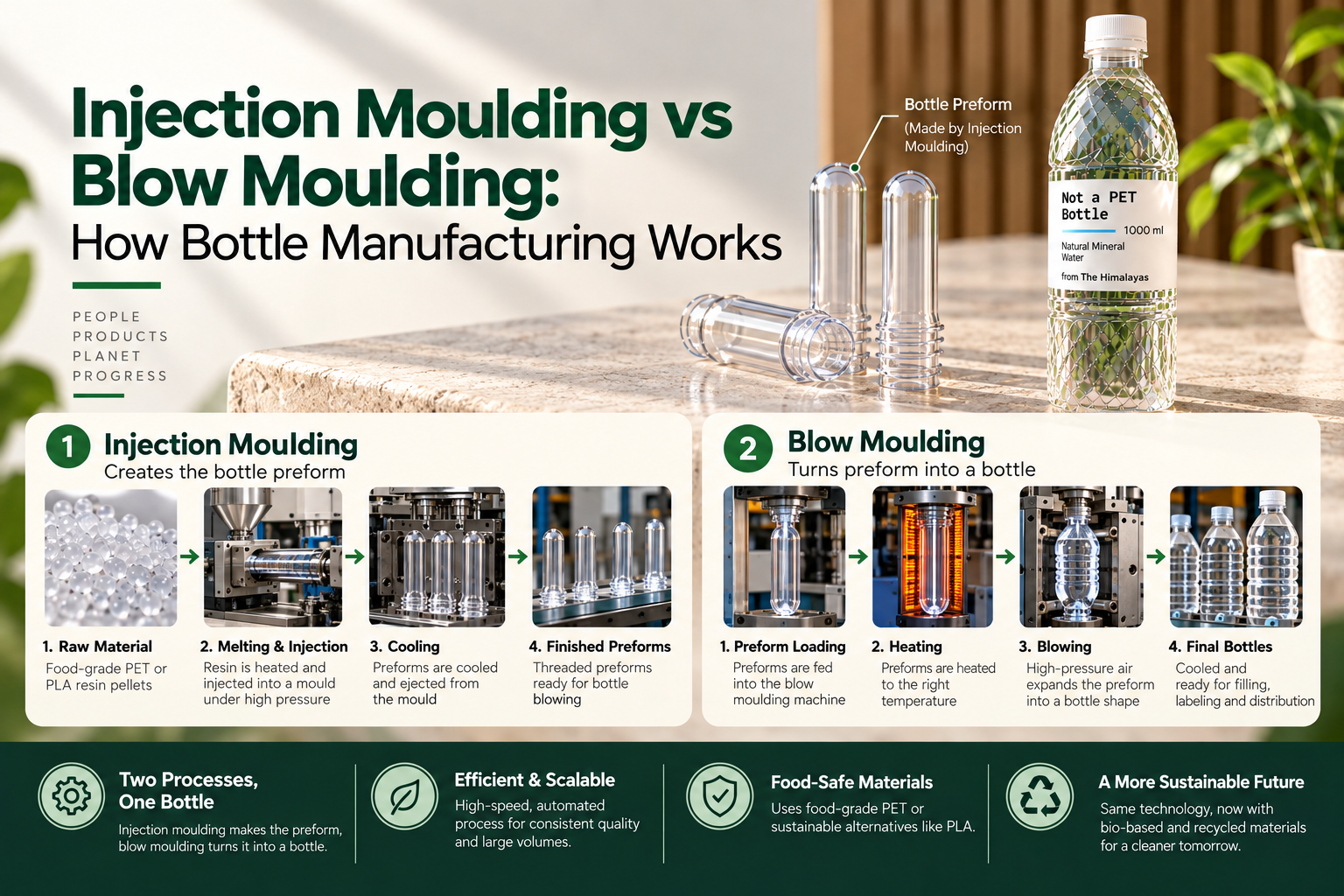
Injection moulding shapes material inside a mould to create a component, such as a bottle preform. Blow moulding uses air pressure to expand suitable heated material inside a mould to create a hollow product, such as a bottle.
Understanding injection moulding vs blow moulding helps businesses evaluate packaging designs, manufacturing requirements and material choices.
What Is Injection Moulding?
Injection moulding is a manufacturing process in which heated material is injected into a closed mould and cooled to form a specific shape.
In bottle manufacturing, this process is commonly used to produce PET preforms.
How it works:
- Plastic resin is prepared for processing.
- The material is heated until it can flow.
- It is injected into a preform mould.
- The material cools and solidifies.
- The mould opens, and the preform is removed.
The resulting preform has a defined neck finish and a closed body. It is not yet a finished bottle.
What Is Blow Moulding?
Blow moulding creates hollow products by expanding heated material inside a mould using air pressure. The mould determines the shape of the finished product.
For PET bottles, a common method is stretch blow moulding.
How it works:
- A suitable preform is prepared and heated.
- The preform is placed inside a bottle-shaped mould.
- It is stretched and expanded using a combination of mechanical stretching and compressed air.
- The material takes the shape of the mould.
- The finished bottle cools and is removed.
The process transforms the preform into a bottle with the required body shape and capacity.
Injection Moulding vs Blow Moulding: Key Differences
| Feature | Injection Moulding | Blow Moulding |
|---|---|---|
| Main purpose | Forms components such as preforms | Forms hollow products such as bottles |
| Basic principle | Material is injected into a mould | Heated material expands inside a mould |
| Typical bottle application | Preform production | Bottle formation |
| Mould design | Defines the component’s shape | Defines the bottle’s external shape |
| Output | A moulded component | A hollow finished product |
| Key considerations | Component dimensions and mould design | Bottle shape, material distribution and process conditions |
These processes are not always alternatives to each other. In conventional PET bottle production, they can be successive stages of the same manufacturing workflow.
How Do Injection Moulding and Blow Moulding Work Together?
A typical PET bottle manufacturing process follows this sequence:
Resin → Injection moulding → Preform → Stretch blow moulding → Finished bottle
Injection moulding creates the preform, while stretch blow moulding expands it into the bottle’s final shape.
Not every bottle follows this exact process. Manufacturing methods vary depending on the material, product design and intended application.
Which Process Is Better for Bottle Manufacturing?
Neither process is universally better. Each serves a different purpose.
Injection moulding is appropriate when a component requires a defined shape and precise moulded features. Blow moulding is suitable for producing hollow containers in a range of shapes and sizes.
For packaging buyers, the important questions are:
- What material is being used?
- What bottle shape and capacity are required?
- Does the design need a particular neck finish or closure?
- What production process is compatible with the material?
- What performance and quality requirements must the finished package meet?
The answers help determine the appropriate manufacturing route.
How Does Material Choice Affect Bottle Manufacturing?
Material characteristics influence processing conditions, mould design and the properties of the finished package. Materials cannot automatically be substituted without checking their compatibility with the manufacturing process.
For example, PET bottle production commonly uses injection moulding to make preforms before stretch blow moulding. Other packaging materials may require different equipment, processing conditions or forming methods.
For businesses exploring plant-based packaging, understanding bottle material characteristics is an important starting point. Material selection should be evaluated alongside the intended application and manufacturing requirements.
What About PLA Packaging?
PLA is a material used in some plant-based packaging applications, but its processing requirements should not be assumed to be identical to those of PET.
Before selecting a manufacturing method for PLA packaging, businesses should evaluate the specific material formulation, processing compatibility, package design and intended use.
Not A PET Bottle provides information about PLA packaging in India for businesses researching alternative packaging materials. The appropriate manufacturing process depends on the particular material and product requirements; the term PLA alone does not establish compatibility with a specific production method.
Frequently Asked Questions
Is injection moulding the same as blow moulding?
No. Injection moulding injects material into a mould to create a component. Blow moulding expands heated material inside a mould to form a hollow product.
Are PET bottle preforms made using injection moulding?
Yes. Injection moulding is commonly used to produce PET preforms, which can then be converted into bottles through stretch blow moulding.
Can blow moulding produce bottles directly?
Yes. Depending on the process and material, blow moulding can form hollow containers directly. PET preform-based production is one common route, but it is not the only bottle-manufacturing method.
Is PLA processed in the same way as PET?
Not necessarily. Processing depends on the specific PLA material and its properties. Compatibility with the required manufacturing equipment and conditions must be established for each application.
Why should packaging buyers understand these processes?
Understanding the manufacturing stages helps buyers ask more informed questions about material compatibility, bottle design, specifications and production requirements before selecting a packaging solution.
Conclusion
Injection moulding and blow moulding perform different but complementary roles in conventional PET bottle manufacturing. Injection moulding commonly produces the preform, while stretch blow moulding transforms it into a finished bottle.
For businesses considering alternative packaging materials, the manufacturing process must be assessed alongside material characteristics and application requirements.
Explore Not A PET Bottle to learn more about our plant-based packaging approach and investigate whether our packaging solutions align with your business needs.