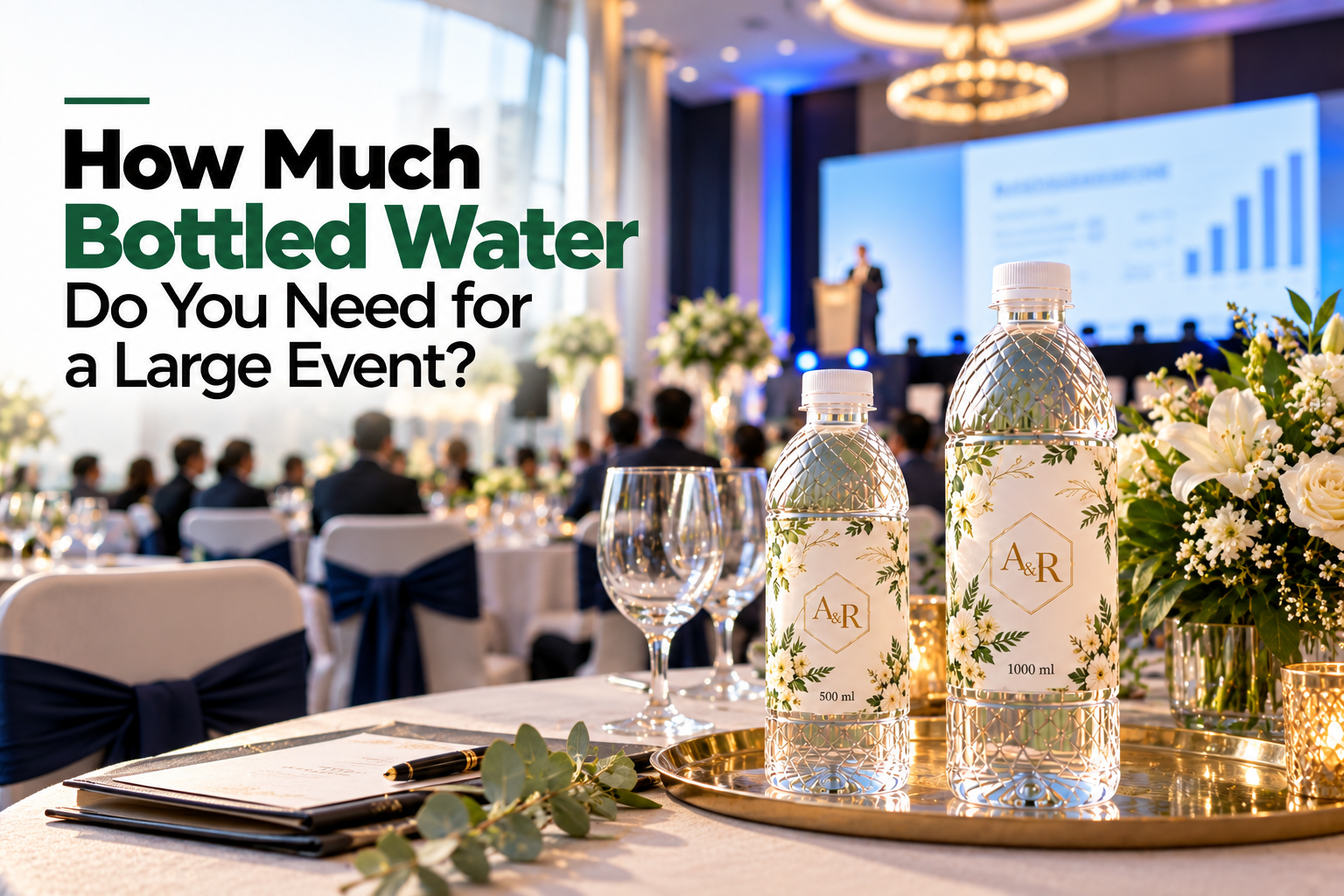
Planning drinking water for a large event requires more than estimating the number of attendees. Event duration, weather, catering arrangements, venue facilities and delivery schedules all affect how much water you need.
Ordering too little can disrupt service, while ordering too much can increase costs and create storage challenges. Whether you are organising a corporate conference, wedding, exhibition, festival or hotel event, a clear calculation helps you plan quantities and manage supplies efficiently.
This guide explains how to estimate bottled water quantity for events, maintain contingency stock and coordinate deliveries. It also explores packaging options for organisers evaluating alternatives to conventional bottled-water packaging.
1. Start With Accurate Attendee Estimates
Your expected attendance is the foundation of your water calculation. Use confirmed registrations, RSVPs or ticket sales wherever possible, rather than venue capacity alone.
Before estimating quantities, establish:
- Expected attendees and event staff
- Event duration and number of sessions
- Indoor or outdoor venue arrangements
- Catering and meal schedules
- Availability of drinking-water dispensers or refill stations
- Whether attendees will move between locations
For multi-day events, calculate each day separately. A full-day conference may have different requirements from an evening networking session, even when attendance is similar.
If registrations are still open, prepare a base estimate and a realistic higher-attendance scenario. This helps you plan a suitable reserve without automatically ordering for the venue’s maximum capacity.
2. Calculate Bottled Water Quantity for Events
A simple starting formula is:
Estimated bottles = Number of attendees × Planned bottles per attendee
For example, if you expect 1,000 attendees and use an illustrative allowance of two 500 ml bottles per person:
1,000 × 2 = 2,000 bottles
This is a planning example, not a universal consumption standard. Actual requirements depend on event length, temperature, activity levels, catering and access to other drinking-water facilities.
For a more practical estimate, consider these factors:
| Event type | Key planning factor |
|---|---|
| Corporate conference | Session duration and catering breaks |
| Outdoor exhibition | Weather and time spent onsite |
| Wedding or reception | Event duration and dining arrangements |
| Festival | Attendance patterns and refill facilities |
| Multi-day event | Daily consumption and replenishment |
If your event includes multiple sessions or venues, calculate each section independently and add the totals.
For a more detailed calculation method, read our guide to calculating bulk bottled water requirements.
3. Account for Event Duration and Conditions
Attendee numbers do not tell the whole story. A two-hour meeting may need less bottled water than an eight-hour conference with multiple sessions.
Review these factors before finalising your estimate:
- Duration: Longer events generally require more opportunities for guests to access drinking water.
- Weather: Hot conditions and outdoor exposure may increase demand.
- Activity: Physical activities and extended periods outdoors can affect consumption.
- Catering: Meals, tea breaks and other refreshments influence how water is served.
- Venue facilities: Refill stations or dispensers may reduce reliance on individual bottles.
- Event schedule: Delays or extended sessions can increase requirements.
Use these factors to choose a reasonable planning allowance for your specific event. Avoid applying the same number of bottles per attendee to every event without considering its conditions.
4. Add a Contingency Reserve
Attendance can change, sessions can run late and weather conditions can differ from expectations. A contingency reserve helps reduce the risk of running out.
Use this formula:
Planned quantity = Estimated demand + Contingency reserve
For example, if estimated demand is 2,000 bottles and you choose an illustrative 10% reserve:
- Estimated demand: 2,000 bottles
- Reserve: 200 bottles
- Total planned quantity: 2,200 bottles
The reserve percentage should reflect the event’s risk and the reliability of replenishment. A remote outdoor event may need a different buffer from a venue where additional supplies are readily available.
Keep reserve stock separate from the main allocation and assign someone to approve its use. This makes it easier to respond to unexpected demand without losing track of inventory.
5. Plan Delivery, Storage and Distribution
A correct quantity estimate is only useful if supplies arrive at the right time and reach the people who need them.
Before confirming your order, coordinate with the supplier and venue on:
- Delivery timing: Agree on a window that fits the event setup schedule.
- Access and unloading: Confirm vehicle access and the designated delivery point.
- Receiving contact: Assign someone to check the order on arrival.
- Storage: Ensure there is suitable space for the full quantity.
- Distribution: Plan how bottles will reach registration desks, meeting rooms, dining areas or service stations.
- Replenishment: Confirm whether additional stock can be arranged and under what conditions.
For large events spread across several areas, allocate stock by location. Track what has been delivered, distributed and reserved so one area does not consume supplies intended for another.
Confirm product availability, minimum order quantities, delivery charges and lead times before relying on a particular supply arrangement.
6. Are Plastic-Free Water Bottles an Option for Large Events?
Event organisers increasingly consider packaging when planning procurement and sustainability initiatives. If you are searching for a plastic free water bottle option, first clarify what the term means for your event and verify the material composition of the specific product.
Reusable glass or stainless-steel bottles may suit some event formats, particularly where washing, collection and reuse can be managed. For events requiring packaged drinking water, organisers may also evaluate alternative packaging materials, including PLA-based bottles, depending on product availability and requirements.
Before choosing an option, check:
- Product and packaging specifications
- Relevant documentation and substantiated material claims
- Available bottle sizes and quantities
- Storage and handling requirements
- Delivery terms and minimum order quantities
- Local disposal, collection or processing arrangements
Do not assume that a bottle is entirely plastic-free based on its appearance or a broad marketing description. Similarly, PLA-based packaging should not automatically be described as compostable in ordinary surroundings. Verify the claims for the specific product and the conditions required for its disposal.
Explore packaged drinking water for product information, and read more about sustainable water for hotels and events.
7. Use a Simple Stock Management Plan
Assign a coordinator to monitor stock before and during the event. A basic inventory sheet should track:
- Opening quantity received
- Bottles allocated to each area
- Stock distributed
- Remaining quantity at scheduled checkpoints
- Reserve stock
- Damaged or missing units
- Closing inventory
For multi-day events, review the balance at the end of each day and separate the next day’s allocation.
If supplies run low, follow the agreed replenishment process and record any stock transferred between areas. This helps prevent one location from using supplies intended for another.
Final Checklist
Before placing your order, confirm that you have:
- Estimated attendance and event duration
- Calculated demand for each day or venue
- Considered weather, catering and refill facilities
- Added an appropriate contingency reserve
- Confirmed product specifications and bottle sizes
- Agreed on delivery, unloading and storage arrangements
- Assigned responsibility for stock and distribution
- Checked supplier availability, lead times and commercial terms
- Verified packaging claims and disposal arrangements
Conclusion
Calculating bottled water quantity for events starts with attendee numbers, but successful planning also depends on event duration, venue conditions, delivery coordination and contingency stock.
Estimate each event or session separately, document your assumptions and assign clear responsibility for inventory. If you are considering a plastic-free or alternative packaging option, verify the product’s actual composition, environmental claims and disposal requirements before making a decision.
Not A PET Bottle focuses on finished drinking water in PLA-based bottles for business enquiries. Share your event requirements through our contact page to discuss possible supply options. Availability, quantities, pricing and delivery arrangements must be confirmed directly.
Frequently Asked Questions
How do I calculate bottled water for a large event?
Multiply expected attendance by a planned bottles-per-attendee allowance, then adjust for duration, weather, catering, refill facilities and other event conditions. Add an appropriate contingency reserve.
How much extra bottled water should I order?
There is no universal reserve percentage. Choose a buffer based on attendance uncertainty, event conditions, storage capacity and how reliably additional supplies can be obtained.
When should bottled water be delivered for an event?
Confirm a delivery window that fits venue access and setup schedules. Agree on unloading, storage, receiving responsibilities and the supplier’s lead time in advance.
Are plastic-free water bottles suitable for large events?
That depends on the specific product and the event’s service arrangements. Evaluate material composition, reuse or disposal requirements, storage, availability and supporting documentation before describing any product as plastic-free.
Can Not A PET Bottle supply bottled water for large events?
Not A PET Bottle focuses on finished drinking water in PLA-based bottles for business enquiries. Potential supply options, quantities, pricing and delivery arrangements must be confirmed directly.