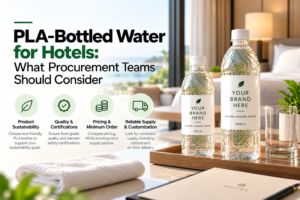
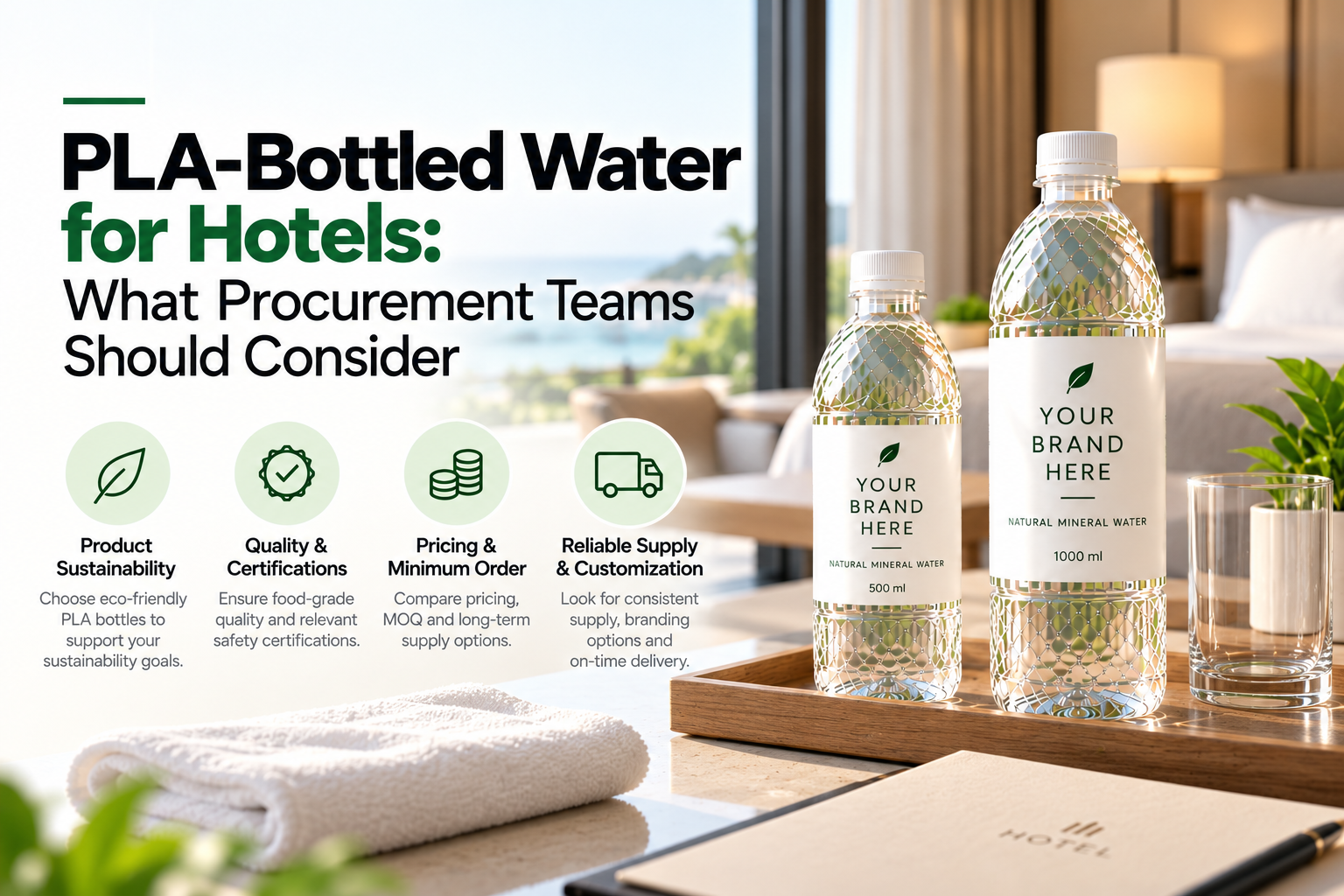
Bottled water is a routine procurement requirement for many hotels. It may be provided in guest rooms, served in restaurants, stocked in meeting rooms, supplied for conferences or included in wedding and hospitality packages. Although each bottle may represent a small purchase, the total requirement can become significant across rooms, guests, events and operating departments.
Choosing bottled water for hotels involves more than comparing the price per bottle. Procurement teams need to evaluate water specifications, packaging formats, supplier reliability, order quantities, storage requirements, delivery schedules and the expectations of their guests.
For hotels reviewing alternatives to conventional PET packaging, PLA-based bottled water may also be worth evaluating. However, the decision should be based on the specific product, supporting documentation, operational requirements and available end-of-life options—not simply on an environmental label.
This guide explains how hotel procurement teams can evaluate bottled water suppliers and determine whether PLA-bottled water is appropriate for their property.
1. Map Where Your Hotel Uses Bottled Water
Before requesting quotations, identify the departments and guest touchpoints that require bottled water. Different uses can have different consumption patterns, packaging preferences and replenishment requirements.
Common applications include:
- Guest rooms: Bottled water supplied as part of the guest experience or room amenities.
- Restaurants and bars: Water served during meals or kept available for guests.
- Meetings and conferences: Bottled water arranged for delegates, speakers and business events.
- Weddings and banquets: Water requirements based on attendance, event duration and service arrangements.
- Lounges and common areas: Water provided in selected guest-facing spaces.
- Corporate and group bookings: Bulk requirements associated with conferences, tour groups and other reservations.
Create a simple list of each department, its estimated consumption, preferred bottle size and replenishment frequency. This gives your procurement team a clearer picture of the overall requirement.
It also helps prevent every department from placing separate, uncoordinated orders that make stock planning and supplier management more difficult.
2. Calculate Your Hotel’s Bottled Water Requirements
Accurate demand planning helps a hotel avoid both shortages and unnecessary inventory. Instead of estimating from room count alone, consider actual occupancy, guest behaviour, restaurant covers, event schedules and the way water is served.
A practical starting formula is:
Estimated daily requirement = Guest-room demand + Food and beverage demand + Event demand + Other operational demand
For guest rooms, you can estimate consumption using occupied rooms, the number of bottles provided per room and your replenishment policy.
For example, a hotel with 100 occupied rooms that provides two bottles per room would require 200 bottles for that room-service allocation. This is an illustration, not a general consumption benchmark.
Food and beverage requirements should be estimated separately using relevant service volumes. Event requirements should account for expected attendance, event duration and the hotel’s service plan.
When forecasting, consider:
- Expected occupancy rather than total room capacity alone
- Weekday and weekend demand patterns
- Seasonal peaks and local events
- Conference, banquet and wedding bookings
- Bottle sizes used across different departments
- A reasonable reserve for unexpected demand
- Supplier replenishment lead times
Review actual consumption against forecasts regularly. Historical purchasing data can help refine future estimates and establish more appropriate reorder levels.
For a more detailed calculation method, see our guide to calculating your business’s bottled water requirements.
3. Evaluate Water Specifications and Product Documentation
Packaging should not be the first or only consideration when selecting a bottled water supplier. Procurement teams must also establish exactly what product is being supplied and whether it meets the hotel’s requirements.
Ask potential suppliers to confirm:
- The product category and water specifications
- Available bottle sizes and packaging formats
- Product labelling and declared information
- Relevant licences, certificates and regulatory documentation
- Batch identification and traceability arrangements
- Storage and handling requirements
- Delivery, damaged-stock and complaint procedures
The hotel’s quality or food-safety team should review relevant documents before approving a product for use.
Requirements can differ depending on the product category and applicable regulations. Verify current requirements with the relevant Indian authorities rather than assuming that one supplier document covers every product or business activity.
If you are considering PLA-based bottles, request documentation relating to the specific packaging used in the supplied product. Do not assume that every bottle described as plant-based has identical material composition, performance or disposal characteristics.
4. Compare Packaging Options for Different Hotel Settings
Hotels may use different packaging formats depending on guest expectations, service requirements, procurement policies and waste-management arrangements.
Conventional PET bottles, glass bottles, aluminium containers and cartons each have different operational characteristics. PLA-based bottles are another option that some buyers may wish to assess.
The right choice depends on the actual product and its intended use.
| Consideration | What procurement teams should evaluate |
|---|---|
| Guest experience | Appearance, convenience, ease of use and suitability for the service setting |
| Product protection | Packaging integrity, storage requirements and supplier handling guidance |
| Logistics | Carton dimensions, storage capacity, transport and ease of replenishment |
| Cost | Purchase price, delivery, handling, wastage and total cost per usable bottle |
| Waste management | Local collection arrangements and the actual disposal route available |
| Documentation | Product specifications and evidence supporting packaging-related claims |
Avoid selecting packaging based on a single attribute. For example, a format that appears suitable for a premium guest room may not be the most practical choice for a large outdoor event.
Evaluate each format against the property’s operating conditions and procurement priorities.
5. What Should Hotels Know About PLA-Bottled Water?
PLA stands for polylactic acid, a polymer commonly produced from fermented plant-derived sugars or starches. It is used in certain packaging applications, including some bottle formats.
PLA-based bottled water may be relevant to hotels exploring alternatives to conventional PET packaging. However, the term “PLA” alone does not establish how a finished bottle performs, how it should be stored or what happens to it after disposal.
Before approving a PLA-based bottled water product, procurement teams should clarify the following.
Confirm the specific packaging material
Ask the supplier what material is used in the bottle and whether any other materials or components are present. Request product-specific documentation instead of relying solely on broad marketing descriptions.
Understand storage and handling requirements
Confirm the supplier’s instructions for storage, temperature exposure, transport and shelf-life management. Make sure the hotel’s receiving and storage processes can accommodate the product.
Review environmental claims carefully
Terms such as plant-based, biodegradable and compostable do not mean the same thing. Plant-derived content does not automatically establish that a product will biodegrade quickly or break down under ordinary disposal conditions.
Ask for evidence supporting any environmental claims made about the specific packaging. Also establish whether suitable collection or processing infrastructure is available for its end-of-life management.
Check suitability for the intended use
Confirm that the supplied product’s specifications and documentation are appropriate for its intended use in the hotel. Do not assume that all products using PLA have identical properties or regulatory status.
For further background, read our guide to PLA packaging and our explanation of what happens to a PLA bottle after disposal.
6. Evaluate Suppliers Beyond the Quoted Price
A low purchase price is not necessarily the best commercial option if deliveries are unreliable, product documentation is incomplete or stock arrives in unsuitable quantities.
When comparing bottled water suppliers, consider the total cost and the supplier’s ability to meet your operating requirements.
Ask each supplier for a written quotation covering:
- Product name and specifications
- Available bottle sizes and packaging formats
- Price per unit and applicable taxes
- Minimum order quantities, where applicable
- Transport and delivery charges
- Delivery locations and confirmed lead times
- Payment terms and quotation validity
- Damaged, missing or incorrect delivery procedures
- Product documentation and traceability
- Availability of repeat orders
Compare quotations using the same assumptions. A price that excludes delivery or applies only to a different order quantity may not be directly comparable with another supplier’s offer.
Hotels should also clarify the process for urgent replenishment, changes in demand and complaints. These details can be important during busy periods, when a missed delivery may affect several departments.
7. Plan Bulk Orders and Replenishment
Bulk purchasing can simplify procurement, but only when order quantities match actual consumption, storage capacity and cash-flow requirements.
Ordering too little may increase the frequency of deliveries or create stock shortages. Ordering too much can occupy valuable storage space, tie up working capital and increase the risk of holding stock longer than planned.
A practical replenishment process should include:
- Consolidate demand: Gather requirements from rooms, food and beverage, events and other departments.
- Review available stock: Check usable inventory and confirmed incoming deliveries.
- Estimate demand during lead time: Calculate expected consumption until the next delivery can arrive.
- Set a reserve: Choose a safety-stock level based on demand variability and supplier reliability.
- Agree on delivery arrangements: Confirm order quantities, delivery windows and receiving procedures.
- Review actual usage: Adjust future orders using purchasing and consumption records.
A simple reorder-point formula is:
Reorder point = Average daily consumption × Replenishment lead time + Safety stock
Use confirmed supplier lead times and the hotel’s own consumption data to calculate the reorder point. Do not rely on generic assumptions when actual records are available.
For more guidance, see our article on ordering PLA-bottled water in bulk for your business.
8. Match Packaging to the Guest Experience
The same packaging format may not suit every area of a hotel. Procurement teams should consider where the bottle will be used and how it fits into the service experience.
For guest rooms, appearance, ease of use and compatibility with room amenities may matter. Restaurants may have different presentation and service requirements. Conferences and banquets may prioritise predictable quantities, efficient distribution and straightforward replenishment.
Before making a property-wide change, consider a structured internal evaluation. Relevant teams may include procurement, housekeeping, food and beverage, events, operations and sustainability.
Their feedback can help identify practical issues involving storage, service, handling, guest expectations and waste collection before a wider purchasing decision is made.
Where appropriate, establish clear internal specifications so that different departments do not independently purchase products that create avoidable complexity.
9. Assess Waste Management Before Making Sustainability Claims
A packaging decision should account for what happens after the bottle has been used—not just how it is described at the point of purchase.
Before choosing PLA-based packaging, establish what waste-management routes are actually available to the hotel. Ask the supplier for disposal guidance for the specific product and consult the hotel’s waste-management provider or relevant local authority.
Do not assume that PLA-based packaging can be processed through every conventional recycling stream or that it will compost in ordinary surroundings. Industrial composting, where applicable, requires suitable facilities and acceptance of the specific material.
If the property communicates environmental benefits to guests, make sure the claims are accurate, specific and supported by evidence. Avoid broad statements such as “fully biodegradable” or “zero impact” unless they are substantiated for the product and the relevant conditions.
A responsible procurement decision considers the complete operating context: product specifications, supplier documentation, practical use and realistic end-of-life options.
10. Create a Hotel Bottled Water Procurement Checklist
Before approving a supplier or changing packaging formats, use a standard checklist to document the decision.
- Have the hotel’s daily and seasonal requirements been estimated?
- Have the relevant departments agreed on bottle sizes and use cases?
- Have product specifications and regulatory documents been reviewed?
- Have supplier prices, taxes and delivery costs been compared?
- Are order quantities aligned with storage capacity and consumption?
- Are replenishment lead times and delivery procedures confirmed?
- Have payment terms and damaged-stock procedures been documented?
- Have packaging claims been checked against product-specific evidence?
- Is there a practical waste-management route for the selected packaging?
- Have the relevant operational teams reviewed the proposed product?
- Have availability and commercial terms been confirmed in writing?
Documenting these checks makes it easier to compare suppliers consistently and explain the basis of the procurement decision.
11. Explore PLA-Bottled Water Supply with Not A PET Bottle
For hotels exploring alternatives to conventional PET packaging, Not A PET Bottle focuses on finished drinking water in PLA-based bottles for businesses evaluating alternative bottled water formats.
This may be relevant to hotels, hospitality groups and event venues reviewing their bottled water procurement options. The appropriate product and commercial arrangement will depend on the hotel’s requirements and what is available.
If you are considering a potential supply arrangement, share details such as your property type, intended use, estimated order quantity, delivery location and expected purchasing frequency.
The team can then review your enquiry and confirm whether a suitable product and supply arrangement may be possible. Product availability, pricing, order quantities, branding options and delivery feasibility must be confirmed directly.
Explore our packaged drinking water offering, browse our products, or contact Not A PET Bottle to discuss your requirements.
Frequently Asked Questions
What should hotels consider when choosing a bottled water supplier?
Hotels should evaluate product specifications, relevant documentation, pricing, delivery reliability, order quantities, storage requirements, payment terms and complaint-handling procedures. The supplier should be assessed against the hotel’s actual consumption and operating needs.
How can a hotel calculate its bottled water requirements?
Estimate demand separately for guest rooms, restaurants, meetings, events and other uses. Combine these estimates, account for peak periods and maintain a suitable reserve based on consumption patterns and replenishment lead times.
Is PLA-bottled water suitable for hotels?
Suitability depends on the specific finished product, packaging specifications, relevant documentation, storage and handling requirements, and the hotel’s intended use. Procurement teams should verify these details before approving a product.
Is PLA packaging always biodegradable or compostable?
No. These terms describe different properties and conditions. Do not assume that every PLA-based product will biodegrade or compost in ordinary surroundings. Verify the claims and disposal guidance for the specific packaging.
How can hotels compare bulk bottled water quotations?
Compare equivalent products and order quantities, including unit prices, taxes, transport, handling, payment terms, delivery schedules and any applicable minimum order quantities. Evaluate the total cost of supply rather than the headline price alone.
How often should hotels reorder bottled water?
Reorder frequency depends on consumption, available storage, order quantities and supplier lead times. Hotels can use consumption records and a reorder-point calculation to establish a suitable schedule and adjust it for seasonal or event-related demand.
Can hotels request branded or private-label bottled water?
Branding options depend on the supplier, product availability and the commercial arrangement. Hotels should confirm whether branding is offered, along with any applicable requirements, costs, quantities and lead times, before making plans.
Does Not A PET Bottle supply PLA-bottled water to hotels?
Not A PET Bottle focuses on finished drinking water in PLA-based bottles for business enquiries. Hotels can share their requirements to discuss possible supply options. Product availability, quantities, pricing and delivery arrangements must be confirmed directly.
Final Thoughts
Choosing bottled water for hotels requires a balance between guest experience, product suitability, reliable supply, total procurement cost and responsible packaging decisions.
Start by measuring actual demand across departments, comparing suppliers on consistent terms and confirming the documentation for each product. If PLA-based bottled water is under consideration, assess the specific packaging and realistic disposal options rather than relying on broad environmental descriptions.
A structured procurement process helps hotels make informed purchasing decisions while keeping day-to-day operations, guest expectations and supply requirements in view.